Tuesday, September 5, 2017

Why Do We Do What We Do?

 From the pages of Kadima, the newsletter of Congregation Adas Emuno:


A Message From Our President


Dr. Lance Strate


Why Do We Do What We Do?


As the summer season comes to close, we now prepare for our annual ritual of renewal, our High Holy Days and Festivals, our New Year and Day of Atonement and At-One-ment, and our celebrations of the divine gifts of nature and scripture, harvest and Torah, sustenance for body and for soul.

But why? Why do we do what we do? A single question, with many answers.


Because we remember.

Because we remember who we are.

Because we remember who we have chosen to be.

Because we love our children, and we do not want them to be deprived of the spiritual dimension of life.

Because we love our children, and we do not want them to be outsiders, estranged from our Jewish community, alienated from our unique civilization.

Because we love learning, and respect the importance of education and ethical conduct alike.

Because we believe in social justice, and that we should not stand idly by.

Because we remember that we are commanded to love our neighbors, and also to love the stranger.

Because we love and respect family and community.

Because we honor our mothers and fathers, and their mothers and fathers, and all those who came before, who preserved this irreplaceable legacy for us, and who lived and died so that we can live our lives in peace and freedom.

Because we remember and honor Abraham's covenant with God.

Because we remember and honor the faith of Abraham and Sarah, Isaac and Rebecca, Jacob and Rachel and Leah.

Because we remember that we were slaves in Egypt.

Because we remember Moses, and the prophetic vision of a world redeemed.

Because we remember Sinai, and honor our obligations to seek justice, love mercy, and walk humbly.

Because we believe that we are called upon to repair and heal the world.

Because we believe in a living tradition that is flexible, and that continues to grow and evolve.

Because we believe in something greater than ourselves.

Because we want to believe in something greater than ourselves.

Because we are not sure what to believe, but are willing to struggle with that question, and are not prepared to surrender without a fight.

Because we do not want 4,000 years of Jewish life to end with us.

Because we remember the Holocaust, and say to the world, never again.

Because we remember the Holocaust, and remember that we are defined by much more than being victims of persecution.

Because we honor the State of Israel, and rejoice in its accomplishments.

Because we honor the State of Israel, and honor the fact that we are defined by much more than a promised land and a holy city and a promise to return.

Because we not bound by place or space, but instead are connected to one another through history, and across time.

Because we honor the past and keep faith with the future, believing in a better world to come, one that we can take part in creating, here on earth.

Because it is meaningful, and gives our lives a significance we cannot obtain though any other means.

Because it matters, to us, to our parents and children, our families and friends, to our neighbors and strangers, to our allies and foes, to the world in both its sacred and profane aspects.

Because it makes a difference, being a deliberate choice we make as to whether the Jewish people and the Jewish faith will continue tomorrow or end today.

Because we remember who we are.

Because we remember we are Jews.

Because we remember.


Thursday, August 31, 2017

High Holy Days at Adas Emuno in Bergen County, New Jersey


High Holy Day Services in Leonia 


Welcome in the New Year 5778!

Rabbi Barry Schwartz and Cantor Sandy Horowitz will lead High Holy Day services at Congregation Adas Emuno beginning on Wednesday evening, September 20 at 8 pm with Erev Rosh Hashanah. Pianist Beth Robin will provide musical accompaniment. 

Children's Services on Rosh Hashanah and Yom Kippur afternoons at 2 pm do not require tickets. 

High Holy Day tickets are available to non-members. 

A full schedule of services can be found on the temple website at www.adasemuno.org.

Congregation Adas Emuno, a Reform synagogue founded in 1871, is located at 254 Broad Avenue, Leonia. For further information, call 201-592-1712.

Sunday, July 30, 2017

The State of the Congregation

 From the pages of Kadima, the newsletter of Congregation Adas Emuno:


A Message From Our President


Dr. Lance Strate


The State of the Congregation


For the past four years, I have begun by stating that the state of our congregation is strong, and I want to begin again by saying that we remain strong as a congregation, despite the challenges that we face.

The source of our strength is in our people: our members, our clergy, our leadership. And so I would like to take this opportunity to acknowledge a group of dedicated, hardworking, and talented individuals. I want to thank our officers, Vice-President Elka Oliver, Financial Secretary Mark Rosenberg, Treasurer Marilyn Katz, and Recording Secretary Susan Grey, for all that they have done for Adas Emuno, and will continue to do for our shul in the future. I also want to thank the other members of our Board of Trustees, Carol Bodian, Annette DeMarco, Michael Fishbein, Judith Fisher, Jody Pogach, Michael Raskin, Norman Rosen, Lauren Rowland, Ronald Waxman, Doris White, Sandra Zornek, and of course our past president, Virginia Gitter. Our board has never shirked its duties or ignored its fiduciary responsibilities to our congregation (the commitment reflected in the late hour that our meetings often run to), and I believe we can all be grateful that there is so much potential for future leadership represented on our board.

While I will not go over every committee and name all of the chairs and volunteers who make things happen, instead I will say that you all are the lifeblood of this congregation, and your contributions are recognized, understood, and treasured.

We continue to be blessed by a dream team of clergy, and I simply cannot say enough about Rabbi Schwartz and Cantor Horowitz. But I will say that our rabbi is a true scholar and teacher, whether he is standing on the pulpit, speaking to individuals in the social hall, teaching Torah Study, adult education or confirmation class, or setting an example by his own efforts at social action. He is our spiritual leader, our role model and guide, and we are so fortunate to have him, and his wife Debby, as part of the Adas Emuno family.

Cantor Horowitz performs her dual role as cantor and religious school director with grace, inspiration, and authority. The beautiful and moving music she brings to our services is echoed by the music that can be heard on Sundays in the voices of our students and teachers engaged in Jewish learning and education. For this reason, I am very pleased to report to the congregation that Cantor Horowitz has signed another two-year contract, so that she will continue on as our Cantor-Educator for the near future. This represents the longest period of continuity regarding our temple’s clergy for many years, certainly longer than I can remember, and I believe we can take pride in this achievement and be thankful for such good fortune.

In support of the Cantor and our services, as well as other activities we take part in, such as musical performances, talent shows, and Purim spiels, we have recently made a major improvement by replacing our old, cobbled-together, secondhand sound system, which was failing, with a new one. It is one that will continue to serve our congregation (which I do not hesitate to characterize as musical and discerning) for many years to come. I want to express our sincere gratitude to Kurt Roberg for his generation donation that enabled us to purchase this new system. A special thanks also to Elka Oliver for spearheading the mission. And on the subject of the Purim spiel, I just want to say that it is such an honor and pleasure for me to be able to help make that one of our many special events and observances.

This past year has been in many ways a quiet year for our congregation, but it also has been one in which we have made our voices heard, becoming political collectively as so many of us have become individually of late. This includes Rabbi Schwartz’s efforts, endorsed by the board, to have Leonia declared a sanctuary city, and our letter of protest to Israeli Prime Minister Benjamin Netanyahu regarding the status of egalitarian worship at the Western Wall. The significance of these efforts lies not in the fact that they did not achieve their stated goals, but in the ways in which we, as a congregation, have become engaged with our community, our nation, and our people.

Our sesquicentennial is just four years away now, and it is imperative that we think about the future, to plan a celebration, but also to insure that our congregation survives for another 150 years. Our greatest challenges remain above all, membership, as our numbers have declined, and the demographics of the area do not work in our favor. We need to put more effort into trying to recruit new members, especially families with school age children, as our religious school enrollments have also gone down. On the bright side, Rabbi Schwartz has spearheaded an effort to establish a temple youth group, and this will serve not only our teens, but our efforts to be more attractive to potential members. But we need everyone working together to keep our little shul on the hill going strong. Financially, we are healthy for the short term, but in the long run we need members to keep us healthy.

We have our work cut out for us, but I think we all know that there is something special about our congregation, something worth working for, and something that makes it very rewarding to do so. I want to call on all of our membership to come to our aid in the coming year, and beyond, to do whatever you can, to go above and beyond, to support our shul, through donations, and through your thoughts and time and participation as congregants, volunteers, and Adas Emuno ambassadors. Our congregation is strong, and with your help, with all of us working together, we will continue to go from strength to strength. Thank you.

June 15, 2017

Saturday, July 29, 2017

Rabbi Schwartz's Report at our Annual Congregational Meeting

Delivered at our annual congregational meeting on June 22nd:

Rabbi's Report for the Year 5777

Each year I submit brief remarks based on the three basic functions of the synagogue as reflected in its Hebrew names: Beit Tefilah (House of Prayer), Beit Midrash (House of Study) and Beit K’nesset (House of Gathering).

Beit Tefilah: Our High Holiday services were full and joyful; the same can be said for our holiday celebrations, especially Hanukkah, Purim and the Pesach congregational Seder. The exception is Simchat Torah, which would benefit from some creative rethinking. I want to once again applaud the parents and students of our school who have made monthly Family Services so invigorating.

Beit Midrash: Our year-long study of the history of Reform Judaism was one of our best Torah study experiences to date. I am grateful for the remarkably strong support given Torah study week-in, week-out, and the vibrant discussion that takes place on a consistent basis. Our religious school, though diminished in numbers, concluded another excellent year, under the able leadership of the Cantor, the faculty, and the education committee. A new youth group was successfully launched in connection with a revised Confirmation program. Special thanks to our youth advisors Sabina Albrech and Samantha Rosenbloom, and to our b’nai mitzvah coordinator Marilyn Katz. Despite these positive developments, it is clear that we will have to grapple in the coming year with the consequences of our declining demographics.

Beit K’nesset: I am especially proud of our interfaith and social justice work this year, including hosting the Leonia Community Thanksgiving Service, our Community Interfaith Sanctuary City Resolution, Western Wall Resolution, and Mitzvah Mall program. Two greatly generous contributions to the synagogue will permit a new enhanced sound system, special youth programming, and other good works granted by the rabbi’s discretionary fund. I conclude, as always, with my sincere gratitude to the Temple Board, to the Cantor, and to our “family of families” for all you do to sustain our “assembly of the faithful” from year to year.


Friday, July 28, 2017

Cantor Horowitz's Report at Our Annual Congregational Meeting

Delivered at our annual congregational meeting on June 22nd:


Cantor's Report for the Year 5777


“Music for a while shall all your cares beguile”, is a well-known song written by the Baroque composer Henry Purcell. Contemporary Rabbi Jonathan Sacks puts a Jewish spin on this thought, when he writes, “Words are the language of the mind. Music is the language of the soul.” Adas Emuno is fortunate to have a strong tradition of musical participation. You are so willing to try new melodies and new music. When I sometimes say, “please feel free to sing along, even if you don’t know the music”–I truly mean it. Song is a form of prayer. It is the expression of our own, unique soul.

And so this past year during Friday night Shabbat services, we have introduced more new music than before. While remaining anchored by familiar music, each week I have endeavored to vary melodies of familiar prayers, while also adding musical settings to text that are less familiar. I introduced music from various contemporary Jewish composers, along with settings of music from other parts of our tradition such as the psalms. I played with something called “contrafaction”imposing a tune from one tradition onto the text from another tradition, or from another part of our own tradition. We sang our Shabbat liturgy using familiar Chanukah and Passover tunes at the time of those holidays; on Memorial Day weekend we sang Lecha Dodi to the tune of America the Beautiful. And in memory of Martin Luther King on the weekend of his birthday I chanted excerpts of some of his famous speeches using Haftarah trope–the trope we use traditionally to chant the words of our own prophets, in honor of this modern prophet.

Looking back at some highlights of the year:

Our high holiday services were once again graced with the presence of our keyboard accompanist Beth Robin. We concluded Rosh Hashanah with celebrating Tashlich down at Overpeck Park by the water with plenty of music and the traditional apples and honey. Delightfully, once again this year congregational members of all ages were in attendance. Again this year we had our “indoor” Music in the Sukkah featuring our own Peter Hays and Michael Scowden on guitar, along with the voices of our teens Stella Borelli and Ula Goldstein. This past year has brought another five b'nei mitzvah students to the bimah. In my role as Cantor I met weekly with each of them, in order to prepare them to chant Torah and Haftarah and lead us in prayer. And those special days were once again graced with the musical accompaniment of Beth Robin.

We will have a report from our Religious School co-chairs but I would like to point out a couple of highlights from this past school year...

We continued the tradition of coming together as a school for special celebrations of the major holidays, as has been done in the past, thanks to help from our school committee and other parent volunteers. I also added a new dimension to our holiday programming this past year, as each individual class was given the responsibility to present a skit, poster or presentation relating to one holiday during the year. Teachers and students alike were enthusiastic about the opportunity and creativity flourished!

Attendance at Family Services continued to be high, thanks to the ongoing success of our policy implemented last year which requires students in the older grades to attend a certain number of Shabbat services each year. Thank you again to Bnei Mitzvah/Family Policy coordinator Marilyn Katz for her efforts on behalf of this program.

Confirmation Class was ably led by Rabbi Schwartz again this past year, who also led the effort to resurrect our Youth Group program. This spring saw several Youth Group events, and we look forward to watching this program continue to grow.

While I believe that the quality of our religious school education overall remains high and continues to expand, unfortunately, we can’t say the same about quantity. Enrollment in grades K-7 was down this past year. I believe that this is a trend that could be reversed, and hope that outreach efforts over the summer will yield some result.

In closing I wish to express my gratitude to the leadership of Adas Emuno, Rabbi Barry Schwartz, President Lance Strate, Ritual Chair Virginia Gitter, Buildings supervisor Michael Fishbein and the other officers and members of the board, for their ongoing support of my efforts. Most of all, I am grateful for the Religious School Parents Committee–ably led by Michael Raskin and Jody Pugach along with Susan Grey and Sandy Zornek. It takes a tremendous amount of work to run a school, and their efforts are tireless. The school after all belongs to the parents, and I feel privileged to have the opportunity to work with them.

Respectfully submitted,
Cantor Sandy Horowitz


Friday, July 14, 2017

Kurt Roberg's 80th Bar Mitzvah Anniversary

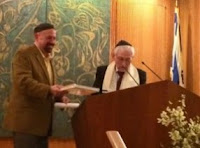
On Friday evening, May 12th, Kurt Roberg, our eldest member, celebrated the 80th anniversary of his bar mitzvah, which took place in Nazi Germany. Kurt was called up for the aliyah, there was a Torah readying from Kurt's portion, and Kurt delivered a special bar mitzvah speech to mark the occasion.


Kurt has been kind enough to share his address with us, for publication in our newsletter, Kadima, and here on our congregational blog. And we are pleased now to share his address with you:


80th Bar Mitzvah Anniversary Address

Kurt Roberg

I am so happy to welcome you all this evening, this certainly is a much bigger turnout than at my original Bar Mitzvah 80 years ago, when in our small congregation in Germany we struggled to assemble 10 men for a minyan.

It is funny how some events in our lives are permanently etched into our memory, and for me that Shabbat in May 1937 certainly is one of them.

I had prepared for my Torah portion for a year under the weekly tutoring of our Hebrew teacher and cantor, and as a result my Torah reading did turn out very well. Then our cantor addressed me, reminding me of my obligations as a Jewish adult; and there were cautions about the difficult times that could lie ahead for German Jews. As a token of my coming of age, I was presented with the traditional Bar Mitzvah gift: a copy of the Holy Scriptures.

After the service had concluded, our family went back to our apartment for a dinner celebration that my mother and Aunt Babette had prepared in advance. My aunt had come from Mother’s birth village near Heidelberg, and my god-parents, Aunt Hedwig and Uncle Robert, had arrived the day before from Paderborn. During those couple of days, we all lived at improvised close quarters in our apartment, because during those Nazi times Jews were no longer allowed in hotels. My brother Harry could not be at my Bar Mitzvah; he had already emigrated a year earlier to my mother’s brother in Holland, and my Uncle Wilhelm refused to travel to Nazi Germany.

Before dinner, everybody gathered in the living room, where another important part of the day's events took place: the presentation of my Bar Mitzvah gifts. Mother had carefully arranged every gift on a table⏤in those days gifts were not wrapped⏤everything was displayed in one overwhelming vision of bliss. There was a fountain pen with a fourteen carat gold tip from Aunt Babette, a Sterling silver pencil from Aunt Hedwig, and a pocketknife from the Salomon family. Uncle Wilhelm had sent twenty Dutch Guilders from Holland and Cousin Helma five Pounds from Palestine. There were some books and sweets and "practical" things like shirts and socks. I was overwhelmed with all those wonderful gifts, but especially the secretly hoped for fountain pen.

As some of you may know, Congregation Adas Emuno was founded in the year 1871 in Hoboken by German/Jewish immigrants. We still have some of the old congregational records, all hand-written in a German script, discontinued long ago. All congregational meetings were held in German and the religious services were performed in German and Hebrew, as were their weekly Religious School classes.

A custom we did not have in Germany, or in Hoboken in those days, but that has become a very laudable tradition in America, is a Bar Mitzvah project. So as my belated Bar Mitzvah project now, I have recently started to study some of those old congregational records. I have deciphered, translated and transcribed the first annual report of its president to the Board of directors, dated October 20, 1872, and an 1873 Report of the School Committee.

Since Tradition and Remembrance are an integral part of Jewish custom and survival, I think it may be of interest to some members of our congregation, as well as our next generation of Bar and Bat Mitzvah’s, to know something about the origin and background of our German/Jewish ancestor congregation. To celebrate my 80th Bar Mitzvah anniversary, in a reversal of procedures, I want to present to you a wonderfully informative book for our library, an illustrated History of the Jews in Germany since Roman times, including the origins of the Reform movement in early 19th century Germany.

In closing, let me thank our Congregation and the Ritual Committee for sponsoring the Oneg Shabbat, Rabbi Schwartz for his caring support and Cantor Horowitz for reading my Parshe today; hopefully I can do that on my 90th anniversary.

Thank you all for sharing this day with me,

Shabbat shalom!

Leonia, May 12, 2017 16 Iyar, 5577


To which we can only add, thank you Kurt, and mazel tov!