Sunday, December 5, 2010
Happy Honika?
Electric Menorah, a name for a popular music act? Or a legitimate alternative to candles? When I was growing up, we always thought electric Menorahs were tacky, for example:
That's something that would be put up by an institution, a school, or in an apartment building lobby, along with the ubiquitous Christmas tree with its electric lights. After all, it doesn't make sense to have something burning when there's no one to watch over it. But for individuals and families to rely on an electric Menorah, that's like, oy!
Real Menorahs burn, like, with fire. Mostly we use candles, but to be really traditional, you can use little bowls of oil, because that's what it originally was about, the burning of purified, sanctified olive oil in a lamp in the Temple, meant to symbolize the light present at Mount Sinai at the time the Torah was given.
And all of this is besides the point, except as a launching pad for me to introduce you to this cool video that brings an electronic, science fiction theme to Chanukah. So let me present to you, Honika Electronica:
So, I wonder if this guy is related to Mel Brooks at all?
Saturday, December 4, 2010
Come Light the Menorah!
Tonight is the official public Menorah lighting, taking place outside of Congregation Adas Emuno, set to begin at 5:30 PM, starting with a Havadalah ceremony, and followed afterwards by a Chanukah party! And when we light the Menorah tonight, it'll be the fourth night, and fourth light being turned on.
As you know, Chanukah lasts for eight days, and we commemorate the holiday by lighting candles, one on the first day, two on the second, and so on until all eight candles on the Chanukah Menorah are lit. The Chanukah Menorah, or Chanukiah, actually uses nine candles typically, one being the shamash or helper, which is used to light the other eight (interestingly, Shamash is the name of the Sumerian sun god). Oh, and just in case it's not obvious, a Menorah is a candelabrum, but when I hear the word candelabrum I can't help but think of Liberace (if this confuses you, never mind, you're probably just too young to get the reference).
So why is this week different from all other weeks? On all other weeks, the Menorahs that are used only have six lights, plus the seventh shamash. The six lights of the standard Menorah correspond to the six points of the Star of David, the symbol of Judaism, but the Menorah itself is said to symbolize the burning bush, and it is said that the design of the Menorah was part of God's revelation to Moses. It was a feature of the Temple in Jerusalem, and remains one of the symbols of our faith, and the Jewish people as a nation. Here's one image of a Menorah, patterned after the one that existed in the ancient Temple:

And here is the Coat of Arms of the State of Israel, where the Menorah is used as a national symbol:

And now, here is a traditional image of a Chanukah Menorah:

And here's the national Menorah of the United States, on the Mall in Washington, DC, courtesy of National Geographic:

And now, these images below look pretty sad after the professional National Geographic photographer's work, but I took them with my camera phone back in 2008 at our community Menorah lighting:


With snow on the ground even, but I can't see Irving Berlin singing, I'm dreaming of a White Chanukah, oy! Pass the latkes, please!
So why is this week different from all other weeks? On all other weeks, the Menorahs that are used only have six lights, plus the seventh shamash. The six lights of the standard Menorah correspond to the six points of the Star of David, the symbol of Judaism, but the Menorah itself is said to symbolize the burning bush, and it is said that the design of the Menorah was part of God's revelation to Moses. It was a feature of the Temple in Jerusalem, and remains one of the symbols of our faith, and the Jewish people as a nation. Here's one image of a Menorah, patterned after the one that existed in the ancient Temple:

And here is the Coat of Arms of the State of Israel, where the Menorah is used as a national symbol:
And now, here is a traditional image of a Chanukah Menorah:

And here's the national Menorah of the United States, on the Mall in Washington, DC, courtesy of National Geographic:

And now, these images below look pretty sad after the professional National Geographic photographer's work, but I took them with my camera phone back in 2008 at our community Menorah lighting:


With snow on the ground even, but I can't see Irving Berlin singing, I'm dreaming of a White Chanukah, oy! Pass the latkes, please!
Friday, December 3, 2010
The Feast of Lights
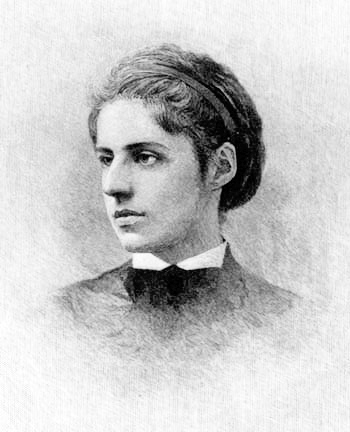
Emma Lazarus (1849-1887) was a Jewish-American poet from New York City who is best known for her sonnet, "The New Colossus," which goes like this:
The New Colossus
Emma Lazarus
Not like the brazen giant of Greek fame,
With conquering limbs astride from land to land;
Here at our sea-washed, sunset gates shall stand
A mighty woman with a torch, whose flame
Is the imprisoned lightning, and her name
Mother of Exiles. From her beacon-hand
Glows world-wide welcome; her mild eyes command
The air-bridged harbor that twin cities frame.
"Keep, ancient lands, your storied pomp!" cries she
With silent lips. "Give me your tired, your poor,
Your huddled masses yearning to breathe free,
The wretched refuse of your teeming shore.
Send these, the homeless, tempest-tost to me,
I lift my lamp beside the golden door!"
That's right! This is the poem that appears on a plaque on the pedestal of the Statue of Liberty.
If you're wondering about the twin cities she makes reference to, they're New York City, and Jersey City (which is actually closer to Liberty and Ellis Island that New York is). And Chanukah itself is a celebration of liberty, after all, so it should come as no surprise that Ms. Lazarus also wrote a poem about the holiday:
The Feast of Lights
Emma Lazarus
Kindle the taper like the steadfast star
Ablaze on evening's forehead o'er the earth,
And add each night a lustre till afar
An eightfold splendor shine above thy hearth.
Clash, Israel, the cymbals, touch the lyre,
Blow the brass trumpet and the harsh-tongued horn;
Chant psalms of victory till the heart takes fire,
The Maccabean spirit leap new-born.
Remember how from wintry dawn till night,
Such songs were sung in Zion, when again
On the high altar flamed the sacred light,
And, purified from every Syrian stain,
The foam-white walls with golden shields were hung,
With crowns and silken spoils, and at the shrine,
Stood, midst their conqueror-tribe, five chieftains sprung
From one heroic stock, one seed divine.
Five branches grown from Mattathias' stem,
The Blessed John, the Keen-Eyed Jonathan,
Simon the fair, the Burst-of Spring, the Gem,
Eleazar, Help of-God; o'er all his clan
Judas the Lion-Prince, the Avenging Rod,
Towered in warrior-beauty, uncrowned king,
Armed with the breastplate and the sword of God,
Whose praise is: "He received the perishing."
They who had camped within the mountain-pass,
Couched on the rock, and tented neath the sky,
Who saw from Mizpah's heights the tangled grass
Choke the wide Temple-courts, the altar lie
Disfigured and polluted--who had flung
Their faces on the stones, and mourned aloud
And rent their garments, wailing with one tongue,
Crushed as a wind-swept bed of reeds is bowed,
Even they by one voice fired, one heart of flame,
Though broken reeds, had risen, and were men,
They rushed upon the spoiler and o'ercame,
Each arm for freedom had the strength of ten.
Now is their mourning into dancing turned,
Their sackcloth doffed for garments of delight,
Week-long the festive torches shall be burned,
Music and revelry wed day with night.
Still ours the dance, the feast, the glorious Psalm,
The mystic lights of emblem, and the Word.
Where is our Judas? Where our five-branched palm?
Where are the lion-warriors of the Lord?
Clash, Israel, the cymbals, touch the lyre,
Sound the brass trumpet and the harsh-tongued horn,
Chant hymns of victory till the heart take fire,
The Maccabean spirit leap new-born!
This poem was published in 1882, and reflects the growing sentiment that formally coalesced as Zionism in 1897; 1882 was the year that many Jews started to immigrate to Palestine (that's what it was called back then), mostly from Russia to escape the pogroms.
So, for us now in the year 2010, Chanukah should serve as a celebration of liberty and freedom for all.
Thursday, December 2, 2010
Happy Chanukah
For the second night of Chanukah, how about a lovely rendition of Ma'oz Tzur, or as it is known in the English translation, Rock of Ages?
This YouTube video was originally posted in 2008, with the following description:
The SHIRAH Choir performs "Ma'oz Tzur" Sunday, December 14, 2008 led Matthew Lazar, Founding Director and Conductor. This concert was held at the Eric Brown Theater, Thurnauer School of Music, Kaplen JCC on the Palisades in Tenafly, NJ. For more information, see www.jccotp.org.
Our thanks to our neighbors over in Tenafly for this marvelous Chanukah treat!
Wednesday, December 1, 2010
Happy Hannukah!
Monday, November 29, 2010
D'var Torah for the Jewish Standard for Chanukah

D’var Torah for Jewish Standard: Miketz/Chanukah
As we reach the season of Chanukah this year, in many of our synagogues, our leaders will be discussing what we’ve come to call “The December Dilemma”. Chanukah can become a difficult time of year for us if we and our children are comparing our December holiday to our Christian friends’ celebrations during this time. The two holidays have absolutely nothing to do with one another in terms of theology. However, in today’s material world, the holidays have become intertwined as an interfaith “festival” of buying. If we fully embrace the materialistic notions of Chanukah, and neglect to consider the roots of our holiday, we have completely lost the essence of what Chanukah represents.
When we focus on the true meaning of Chanukah, we come back to the very root of the word. Chanukah itself means rededication. Our December holiday reminds us to celebrate the rededication of the Temple in Jerusalem. It is significant that the word is rededication rather than dedication. Of course, the Beit Hamikdash had already been dedicated and it makes sense that as it was dedicated once again, it becomes a rededication. But as a spiritual commentary, the word rededication allows us to look within ourselves and see where we have not been as Jewishly dedicated as we would have liked to be.
In the prayer, Al Hanisim, we are also reminded to celebrate the rededication of our people to the very idea of Judaism! We recite, “the iniquitous Greco-Syrian kingdom rose up against Your people Israel, to make them forget Your Torah.” Later in the prayer, we say, “Your children entered the sanctuary of Your house, cleansed Your temple, purified Your sanctuary, kindled lights in Your holy courts, and appointed these eight days of Hanukkah in order to give thanks and praises unto Your holy name." In order to rededicate themselves, our ancestors had to first realize that they had lost sight of what was important. Once they had confronted their own failings, they could begin again to dedicate themselves through physical labor and spiritual endeavor in the holy Temple.
This year, may our December dilemma be, “How will we rededicate ourselves to living a Jewish life and living in the way that God wants us to?” and, “During our Festival of Lights, how will we rekindle the flames within our souls?”
I know that my own answers to these questions are unusual. Having recently returned from a journey to Rome with 19 other Reform cantors from all over North America to sing in the Italian State Basilica, my thoughts have been focused on interfaith relations and in particular, Jewish-Catholic relations. I have been formally involved in Jewish-Christian dialogue for ten years through the Center for Christian-Jewish Understanding at Sacred Heart University in Fairfield, CT. My favorite thing about interfaith dialogue is that it always brings me back to my own faith with a deeper appreciation and understanding of our traditions.
Our journey was full of wonderful experiences and also some disappointments. While discussing some of the minor disappointments of the trip, Rabbi Mark Winer, a chair of the International Interfaith Task Force of the World Union for Progressive Judaism, responded to our regret. He reminded us to view our concert and interactions with Vatican officials as the beginning of a journey.
I returned home to hear news that Pope Benedict XVI had published personal comments calling Pope Pius a "great, righteous" man who "saved more Jews than anyone else". These comments cause pain to most Jewish people. My response to the comments this time was that I will continually rededicate myself to the important work of interfaith dialogue, no matter how difficult it becomes.
The last day of Chanukah marks the dedication of the altar in the Holy Temple. In some communities this is seen as the end of the High Holiday season and people wish each other, “Gmar chatimah tovah (may you be sealed for good).” As we enter this Chanukah season, may we confront our obstacles with the strength and ingenuity that our ancestors showed. May we rededicate ourselves as individuals and as a community to Jewish living and to righteousness.
Sunday, November 28, 2010
Concert Video
Dear friends,
I just received a very special gift this Thanksgiving! The entire concert in Rome, To God's Ears, is posted on YouTube. I've enclosed the link. Enjoy!
Subscribe to:
Posts (Atom)