Tuesday, January 10, 2012

A Reform Hazzan for Fordham Hoops

I couldn't resist sharing this news story here on our congregational blog, as it involves a cantor from one of our sister congregations, and the institution of higher learning where I work and teach, Fordham University.  


As you know, hazzan is the Hebrew word for cantor, traditionally the individual who helps to lead the Jewish prayer service.  This requires proficiency in Hebrew, and also musical proficiency, as the Hebrew prayers are traditionally sung or chanted (the root meaning of cantor being chant).  The role has evolved over the years, from amateur to professional, and from lay to clerical.  I'll refer you to Wikipedia for its articles on the traditional role of the Hazzan, and the contemporary role as a member of the clergy of the Cantor in Reform Judaism .


And as for hoops, that means basketball, but maybe you already knew that.


So, with all this in mind, let me turn to a New York Times article dated January 9, 2012, and written by Clyde Haberman. The title is At Jesuit School, a Pregame Assist From a Jewish Singer.  And it begins like this:
If you’re hoping for a talisman to improve your team’s chances of victory, why not make it a man with a talis?
Great pun, although I wonder how many readers actually got it?  As you know, the talis is the Ashkenazic spelling and pronunciation for the prayer shawl traditionally used in Jewish worship, in particular to be worn whenever the Torah is taken out.  And yeah, you can check it out on Wikipedia, it's listed under the Sephardic dialect's spelling, Tallit. Now, back to the article:
That thought, at any rate, crossed the minds of officials at Fordham University, the Jesuit redoubt in the Bronx. Their men’s basketball team caught a hot hand during the Christmas break when a cantor named Daniel Pincus began singing “The Star-Spangled Banner” before home games.
All right, Cantor Pincus!  And here's a picture of him, in case you wanted to see:


And guess what?  He's wearing a talis, man!  And hey, you can check out his official webpage: http://cantordanielpincus.com and even listen to a recording of him singing, well, not the National Anthem, but a Hebrew prayer, a Sephardic rendition of V'Shameru.  Okay, now back to Haberman's news item:
Normally, the national anthem is sung by the school’s choir, but the choir went on an out-of-state tour during the holiday recess. Mr. Pincus, 57, who is a cantor at Congregation Shaarei Shalom, a Reform synagogue in Riverdale, the Bronx, had already expressed an interest in performing the pregame ritual for Fordham.
In case any you don't ever cross over the George Washington Bridge, and/or aren't all that familiar with the Big Apple, Riverdale is the section of the Bronx closest to Manhattan, just across the river from the island, and it's a lovely residential section.  Like many New York area Jews, I had cousins who lived there back in the day, and they belonged to this Temple.


Anyway, if you're interested in learning more about our sister shul, Congregation Shaarei Shalom, the link is there for your convenience.  All right, back to the story:
“I said to him then that we generally have the choir sing, so let’s see what occurs down the road,” said Julio Diaz, the university’s associate athletic director. Now, unexpectedly, Mr. Diaz found himself down that road. “So I picked up the phone,” he said, “and told him, ‘Cantor, I need your help.’” 
I don't know why the choir wasn't available, but I will just mention that Fordham is outstanding in many ways.  But when in comes to music, well, not so much. So, please continue:
On Dec. 22, before a game against Texas State University, Mr. Pincus made his debut at the Rose Hill campus in the Bronx, singing without his yarmulke and definitely without a talis (which is one way to render the Hebrew word for a Jewish prayer shawl). Fordham won.
He sang a second time a week later against Georgia Tech. Fordham won again. A few days after that, in the first game of the new year, the visitor was nationally ranked Harvard. Fordham, whose nickname is the Rams, triumphed yet again.
Suddenly, a team that had a losing record before Mr. Pincus showed up was on a roll. Could it be that the Jewish singer had become a good-luck charm for the Jesuit school?
The cantor, for one, doubted it. As “cute” as that notion might be, he said, and as “wonderful” as the interfaith aspect of the relationship is, he was performing as “a classically trained tenor.”
“What I wanted was to bring a classical approach and a singable approach to the national anthem,” he said. “I render it in a traditional way — not hip-hop, not jazz.” And, he added, “if I sing it well and with spirit then maybe it helps everybody tune up.”
The cantor’s singing style was important to Mr. Diaz. “I just want to make sure that we have someone who sings it in a patriotic, proper way,” he said.
Like Mr. Pincus, the coach of the basketball team, Tom Pecora, has a skeptical view of the talisman idea — up to a point. “As a college coach for over 25 years, I think it has a little more to do with defense and rebounding,” Mr. Pecora said. “But we’ll include the cantor if that’s what it takes to win games.”
His attitude reflects an element of superstition that is inherent to sports, perhaps more than to other phases of life.
There’s the school of thought upheld by a character in the 1988 baseball movie “Bull Durham.” You have to “respect the streak,” he says. If you think you’re winning because you keep following the same pattern — like having a cantor sing the anthem — then you are.
“We are superstitious, players and coaches,” Mr. Pecora agreed.
The relationship between sports and superstition, well, that's well known, as Haberman notes.  As for the relationship between religion and superstition, well that's one of the things that the Reform movement in Judaism traditionally addressed, as a product of the rationalism of the Enlightenment.  And as for the relationship between religion and sports, my only comment is, oy!
But there is another school, a more cynical one, especially for this age of the genuflecting Tim Tebow and his imitators. This comes from a classic boxing movie from 1956, “The Harder They Fall.” A prizefighter with a powder-puff punch and a glass jaw is on his knees praying before a match. Seeing this, a mobster tells him with a sneer, “That only works if you can fight.”
In basketball, it works only if you outplay the other guys. On Saturday, Fordham fell to earth. Despite having Mr. Pincus sing once more, the team’s home-court winning streak ended when it lost, 67-59, to Xavier University of Cincinnati. So it goes.
But even though the Fordham choir is about to return from its travels, Mr. Pincus expects to be invited back for future games. “It seems now like I’m becoming part of the family, which is great,” he said.
And why not?  It's all about community, which makes this YouTube video of Cantor Pincus singing Hineh Ma Tov all the more fitting:


And now, let's return for the conclusion of the article:
And why not? Among his talents, the cantor teaches the art of the shofar, the ram’s horn that is sounded on the Jewish High Holy Days.
From the ram’s horn to the Rams is not too great a leap.
And let me just note that there is no coincidence to the fact that Fordham chose a biblical animal as its mascot.  And as for Jewish-Catholic and interfaith relations, well, this is a Bronx tale and a New York story, and we live in the New York Metropolitan Area after all.  So, Go Rams!


Sunday, January 1, 2012

Mademoiselle

As we begin the secular new year, we might well reflect on our good fortune in being able to live our lives in relative comfort and safety, compared to what so many experienced not so very long ago.  And we would do well to give thanks for those with the courage to remain righteous in dark times, and let their actions serve as an example to guide and inspire us as we face whatever shadows we may encounter in our own time.


My cousin in Israel shared the following music video with me, which I found very moving in the story it relates (sung in Hebrew, with English subtitles), and in the stunning vocals of Keren Hadar.  According to the write up on YouTube, the song, written by Dalia and Shaul Harel, Dan Almagor, and Rafi Kadishzon, was "written in honor of Andree Geulen on the occasion of her 90th birthday. In Belgium, during the Holocaust, she undertook the rescue of many Jewish children."


The song's YouTube page also provides an extended explanation of how the song came to be:


A song is born. 
In summer 1942, as persecution of Belgium's Jews began, an underground Jewish group took form in cooperation with the Belgian underground and set out to rescue Jewish children by hiding them in various places around the country. The most active team consisted of twelve-women, mostly non-Jewish, who managed to hide some 3000 children. This admirable clandestine campaign was unique by the complexity of its structure and the degree of its success. 
The only survivor from the team today is Andrée Geulen, and on September 4, a great number of the children who had been hidden celebrated her ninetieth birthday. The celebration included a screening of a DVD in which singer Keren Hadar performed a song in her honor. The song stirred a great deal of emotion. 
This song, composed very shortly before the event, arose from an impulse on the part of one of the hidden children — Shaul Harel, who today is a professor of pediatric neurology. 
... and this is how it happened: 
One warm summer day at the Isrotel Dead Sea Hotel, the Harel family was visiting for a performance of the opera Aïda at Massada. Shaul Harel was lolling alone in the whirlpool bath. As the warm water and the complete solitude began to take effect, he wondered intensely what gift he could bring to Andrée for her birthday. "After all, she already has everything. After the war, she married a Jewish attorney, they were blessed with two daughters and with grandchildren and great-grandchildren, and to this day she is surrounded by the love of the children she rescued." Suddenly, as to Archimedes in his warm bath, the Muse descended to him. Although he did not emerge with a mathematical equation — since mathematics was never his subject — he just as suddenly decided to write her a poem. And this is not to be taken lightly, since for many years he had written nothing but medical documentation and articles. The warmth of the water and the atmosphere brought lines tumbling into his mind, and as if possessed, he burst into the hotel room and told his wife Dalia to sit down and transcribe because otherwise the lines would "get away" from him. His wife raised her eyebrows, thinking that the desert heat had overpowered him. But she consented and soon a poem was on paper telling Andrée's story. Shaul's imagination took him further and he said that the poem should be set to music and his favorite singer, Keren Hadar, should perform it. Since the poem was written in free verse, Dahlia worked rhymes into it. The poem was read to Keren and she was moved to tears. She said that it was suitable for setting to music and that she would like to sing it. She recommended Rafi Kadishzon, a prolific and well-known composer. Rafi heard the poem, liked it, and immediately recommended Dan Almagor, a master of the Hebrew word, to adjust the text for the music. In the end, Dan Almagor contributed greatly to the rhythm, to the refrain, and to the perfect fit of the lyrics. 
All this occurred in the course of two weeks. A week later, the song was recorded, the DVD visuals were prepared, and copies were printed with graphics and with a French and English translation. Everyone who saw it was moved, and now here it is for you.

And for the inspiration, poetry, inspired musical composition, and generosity in sharing these beautiful sounds, images, and story, we can also be grateful.

Saturday, December 31, 2011

Obama at the URJ

To close the year out, we would like to include on our congregational blog President Obama's rather remarkable address to the Biennial of the Union of Reform Judaism, of which Adas Emuno is a member.


The half hour speech can be found on YouTube under the title of President Barack Obama - 2011 URJ Biennial Plenary, but you can view and listen to it right here:


And if you prefer to read the remarks instead, or to read while listening, you can find Remarks by the President at the 71st General Assembly of the Union for Reform Judaism online, but again, we will include them here as well, for your convenience:


The White House
Office of the Press Secretary
For Immediate Release
December 16, 2011
Remarks by the President at the 71st General Assembly of the Union for Reform Judaism
Gaylord Hotel
National Harbor, Maryland
2:37 P.M. EST

THE PRESIDENT: Thank you so much. Thank you, everybody. Thank you. Please, please have a seat. You’re making me blush. (Laughter.) Thank you, Eric, for that extraordinary introduction and for your many years of leadership in the Reform movement. And even though it is a few hours early, I’d like to wish all of you Shabbat shalom. (Applause.)


Now, there are a lot of familiar faces in the house: David Saperstein. (Applause.) Alan Solow, Rick Jacobs. (Applause.) Howard Kohr.


I want to welcome Israel’s Deputy Prime Minister and Defense Minister Ehud Barak. (Applause.) The cooperation between our militaries has never been stronger, and I want to thank Ehud for his leadership and his lifelong commitment to Israel’s security and the quest for a just and lasting peace. (Applause.)
I also want to recognize Israeli Ambassador Michael Oren, who’s with us here today. (Applause.)
And finally, I want to give a shout-out to NFTY, I understand is in the house. (Applause.) Young people are going to lead the way, and they’re leading the way. (Applause.) There you go. I’m fired up just listening to them. (Laughter and applause.)


I am honored to be here because of the proud history and tradition of the Union for Reform Judaism, representing more than 900 congregations, around 1.5 million American Jews.


I want to congratulate all of you on the golden anniversary of the Religious Action Center. (Applause.) As Eric mentioned, When President Kennedy spoke to leaders from the RAC in 1961, I was three months old, so my memory is a bit hazy. (Laughter.) But I am very familiar with the work that you’ve done ever since, and so is the rest of America.


And that’s because you helped draft the Civil Rights Act and the Voting Rights Act. (Applause.) You helped to liberate Soviet Jews. (Applause.) You have made a difference on so many of the defining issues of the last half-century. And without these efforts, I probably wouldn’t be standing here today. So thank you. Thank you. (Applause.) You have brought to life your faith and your values, and the world is a better place for it.


Now, since my daughter Malia has reached the age where it seems like there’s always a Bar or Bat Mitzvah -- (laughter) -- every weekend, and there is quite a bit of negotiations around the skirts that she wears at these Bat Mitzvahs -- (laughter) -- do you guys have these conversations as well? (Laughter.) All right. I just wanted to be clear it wasn’t just me. (Laughter.) What time you get home.


As a consequence, she’s become the family expert on Jewish tradition. (Laughter.) And if there’s one thing I’ve learned from her, it’s that it never hurts to begin a speech by discussing the Torah portion. It doesn’t hurt. (Laughter and applause.)


So this week -- (applause) -- congregations around the world will retell the story of Joseph. (Applause.) As any fan of Broadway musicals will tell you -- (laughter) -- there is a lot going on in this reading. (Laughter.) But many scholars have focused on a single word that Joseph uses when he replies to his father Jacob.


In Hebrew, that word is “hineni.” It translates -- (applause) -- it translates to “Here I am.” Hineni. It’s the same word Abraham uses to reply to God before the binding of Isaac. It’s the same word Moses uses when God summons him from the burning bush. Hineni. The text is telling us that while Joseph does not know what lies ahead, he is ready to answer the call.


In this case, “hineni” leads Joseph to Egypt. It sets in motion a story of enslavement and exodus that would come to inspire leaders like Martin Luther King as they sought freedom. It’s a story of persecution and perseverance that has repeated itself from Inquisition-era Spain to Tsarist Russia to Hitler’s Germany.


And in that often-tragic history, this place, America, stands out. (Applause.) Now, we can’t whitewash the past. Like so many ethnic groups, Jews faced prejudice, and sometimes violence, as they sought their piece of the American Dream. But here, Jews finally found a place where their faith was protected; where hard work and responsibility paid off; where no matter who you were or where you came from, you could make it if you tried. Here in America, you really could build a better life for your children.
I know how much that story means to many of you, because I know how much that story means to me. My father was from Kenya; my mother was from Kansas –- not places with a large Jewish community. (Laughter.) But when my Jewish friends tell me about their ancestors, I feel a connection. I know what it’s like to think, “Only in America is my story even possible.” (Applause.)


Now -- I have to interrupt. My friend Debbie Wasserman Schultz just got in the house. (Applause.) Now, the Jewish community has always understood that the dream we share is about more than just doing well for yourself. From the moment our country was founded, American Jews have helped make our union more perfect. Your parents, your grandparents, your great-grandparents, they remembered what it was like to be a stranger, and as a result treated strangers with compassion. They pursued tikkun olam, the hard work of repairing the world. (Applause.)


They fought bigotry because they had experienced bigotry. They fought for freedom of religion because they understood what it meant to be persecuted for your religious beliefs. Our country is a better place because they did. The same values that bring you here today led Justice Brandeis to fight for an America that protects the least of these. (Applause.) Those same values led Jewish leaders to found RAC 50 years ago. (Applause.) They led Abraham Joshua Heschel to pray with his feet and march with Dr. King. (Applause.) And over the last three years, they have brought us together on the most important issues of our time.


When we began this journey, we knew we would have to take on powerful special interests. We would have to take on a Washington culture where doing what’s politically convenient is often valued above doing what’s right; where the focus is too often on the next election instead of the next generation. (Applause.)


And so time and time again, we’ve been reminded that change is never easy. And a number of the rabbis who are here today, when I see them, they’d been saying a prayer. They noticed my hair is grayer. (Laughter.) But we didn’t quit. You didn’t quit. And today, we’re beginning to see what change looks like.


And Eric mentioned what change looks like. Change is the very first bill I signed, the Lilly Ledbetter Fair Pay Act, which says in this country an equal day’s work gets an equal day’s pay. That’s change. (Applause.)


Change is finally doing something about our addiction to oil and raising fuel-efficiency standards for the first time in 30 years. That’s good for our economy. It’s good for our national security. (Applause.) And it’s good for our environment.


Change is confirming two Supreme Court justices who will defend our rights, including our First Amendment rights surrounding religion -- happen to be two women, by the way. That’s also a good thing. (Applause.)


Change is repealing “don’t ask, don’t tell,” so that in the first time in history, you don’t have to hide who you love to serve the country that you love. That’s change. (Applause.)


Change is working with the Reform movement, and other faith-based groups, to reform the federal faith-based initiatives, improving the way we partner with organizations that serve people in need. Change is health care reform that we passed after a century of trying, reform that will finally ensure that in the United States of America, nobody goes bankrupt just because they get sick. That’s change. (Applause.)


Change is the 2.5 million young people -- maybe some of those NFTY folks who have already -- (applause) -- who have health insurance on their parents’ plans because of Affordable Care Act. That’s change. (Applause.)


It’s making family planning more accessible to millions of Americans. (Applause.) It’s insurance companies not being able to charge you more just because you’re a woman, or deny you coverage if you have breast cancer. (Applause.)


Change is committing to real, persistent education reform, because every child in America deserves access to a good school and to higher education -- every child. (Applause.)


And change is keeping one of the first promises I made in 2008: After nearly nine years, our war in Iraq is ending this month and our troops are coming home. (Applause.)


That’s what change is. And none of this would have happened without you. That’s the kind of change we’ll keep fighting for in the months and years ahead.


And just last night, you took another step towards the change we need and voted for a set of principles of economic justice in a time of fiscal crisis. (Applause.) And I want to thank you for your courage. That statement could not have come at a more important time. For as you put it, we’re at a crossroads in American history. Last Tuesday, I gave a speech in Osawatomie, Kansas, where I described that crossroads. And I laid out a vision of our country where everybody gets a fair shot, and everybody does their fair share, and everyone plays by the same rules. (Applause.) And these are not Democratic values or Republican values; they’re not Christian values or Jewish values or Hindu or Muslim values -- they’re shared values, and we have to reclaim them. We have to restore them to a central place in America’s political life. (Applause.)


I said it last week, I’ll say it again: This is not just a political debate. This is a moral debate. This is an ethical debate. It’s a values debate. It’s the defining issue of our time. It is a make-or-break moment for the middle class and for all those who are fighting to get into the middle class. (Applause.) And for those of us who remember parents or grandparents or great-grandparents who had to fight to get in the middle class, but they understood that the American Dream was available to them because we were all in it together -- that’s what this is about. (Applause.) And last night, you reaffirmed the moral dimension of this debate. (Applause.)


We have to decide who we are as a country. Is this a place where everyone is left to fend for themselves? The most powerful can play by their own rules? Or do we come together to make sure that working people can earn enough to raise a family, send their kids to college, buy their own home, have a secure health care and a secure retirement? That is the story that almost all of us here share, in one way or another. This is a room full of folks who come from immigrants, and remember what it was like to scratch and claw and work. You haven’t forgotten. You know what it’s like to see those in your own family struggle.


Well, we have to apply those same values to the American family. We’re not a country that says, you’re on your own. When we see neighbors who can’t find work or pay for college or get the health care they need, we answer the call -- we say, “Here I am.” And we will do our part. (Applause.)


That’s what you affirmed last night. But more importantly, it’s what you affirm every day with your words and your actions. And I promise you that as you pray with your feet, I will be right there with you every step of the way. (Applause.) I’ll be fighting to create jobs, and give small businesses a chance to succeed. I’ll be fighting to invest in education and technology. I will fight to strengthen programs like Medicare and Social Security. (Applause.) I will fight to put more money in the pockets of working families. I won’t be afraid to ask the most well-off among us -– Americans like me –- to pay our fair share, to make sure that everybody has got a shot. I will fight alongside you every inch of the way. (Applause.)


And as all of you know, standing up for our values at home is only part of our work. Around the world, we stand up for values that are universal -- including the right of all people to live in peace and security and dignity. (Applause.) That’s why we’ve worked on the international stage to promote the rights of women -- (applause) -- to promote strategies to alleviate poverty -- (applause) -- to promote the dignity of all people, including gays and lesbians -- (applause) -- and people with disabilities -- (applause) -- to promote human rights and democracy. And that’s why, as President, I have never wavered in pursuit of a just and lasting peace -- two states for two peoples; an independent Palestine alongside a secure Jewish State of Israel. (Applause.) I have not wavered and will not waver. That is our shared vision. (Applause.)


Now, I know that many of you share my frustration sometimes, in terms of the state of the peace process. There’s so much work to do. But here’s what I know –- there’s no question about how lasting peace will be achieved. Peace can’t be imposed from the outside. Ultimately, it is the Israelis and the Palestinians who must reach agreement on the issues that divide them. (Applause.)


And the fact that peace is hard can’t deter us from trying. Because now more than ever, it’s clear that a just and lasting peace is in the long-term interests of Israel. It is in the long-term interests of the Palestinian people. It is in the interest of the region. It is the interest of the United States, and it is in the interest of the world. And I am not going to stop in pursuit of that vision. It is the right thing to do. (Applause.)


Now, that vision begins with a strong and secure State of Israel. (Applause.) And the special bonds between our nations are ones that all Americans hold dear because they’re bonds forged by common interests and shared values. They’re bonds that transcend partisan politics -- or at least they should. (Applause.)


We stand with Israel as a Jewish democratic state because we know that Israel is born of firmly held values that we, as Americans, share: a culture committed to justice, a land that welcomes the weary, a people devoted to tikkun olam. (Applause.)


So America’s commitment -- America’s commitment and my commitment to Israel and Israel’s security is unshakeable. It is unshakeable. (Applause.)


I said it in September at the United Nations. I said it when I stood amid the homes in Sderot that had been struck by missiles: No nation can tolerate terror. And no nation can accept rockets targeting innocent men, women and children. No nation can yield to suicide bombers. (Applause.)


And as Ehud has said, it is hard to remember a time when the United States has given stronger support to Israel on its security. In fact, I am proud to say that no U.S. administration has done more in support of Israel’s security than ours. None. Don’t let anybody else tell you otherwise. It is a fact. (Applause.)


I’m proud that even in these difficult times we’ve fought for and secured the most funding for Israel in history. I’m proud that we helped Israel develop a missile defense system that’s already protecting civilians from rocket attacks. (Applause.)


Another grave concern -– and a threat to the security of Israel, the United States and the world -– is Iran’s nuclear program. And that’s why our policy has been absolutely clear: We are determined to prevent Iran from acquiring nuclear weapons. (Applause.) And that’s why we’ve worked painstakingly from the moment I took office with allies and partners, and we have imposed the most comprehensive, the hardest-hitting sanctions that the Iranian regime has ever faced. We haven’t just talked about it, we have done it. And we’re going to keep up the pressure. (Applause.) And that’s why, rest assured, we will take no options off the table. We have been clear.


We’re going to keep standing with our Israeli friends and allies, just as we’ve been doing when they’ve needed us most. In September, when a mob threatened the Israeli embassy in Cairo, we worked to ensure that the men and women working there were able to get out safely. (Applause.) Last year, when raging fires threatened Haifa, we dispatched fire-fighting planes to help put out the blaze. (Applause.)
On my watch, the United States of America has led the way, from Durban to the United Nations, against attempts to use international forums to delegitimize Israel. And we will continue to do so. (Applause.) That’s what friends and allies do for each other. So don’t let anybody else tell a different story. We have been there, and we will continue to be there. Those are the facts. (Applause.)


And when I look back on the last few years, I’m proud of the decisions I’ve made, and I’m proud of what we’ve done together. But today isn’t about resting on our laurels. As your tradition teaches, we’re not obligated to finish the work, but neither are we free to desist from it. (Applause.)


We’ve got to keep going. So today we look forward to the world not just as it is but as it could be. And when we do, the truth is clear: Our union is not yet perfect. Our world is still in desperate need of repair. And each of us still hears that call.


And the question is, how we will respond? In this moment, every American, of every faith, every background has the opportunity to stand up and say: Here I am. Hineni. Here I am. I am ready to keep alive our country’s promise. I am ready to speak up for our values at home and abroad. I am ready to do what needs to be done. The work may not be finished in a day, in a year, in a term, in a lifetime, but I’m ready to do my part. (Applause.)


And I believe that with tradition as our guide, we will seize that opportunity. And in the face of daunting odds, we will make the choices that are hard but are right. That’s how we’ve overcome tougher times before. That’s how we will overcome the challenges that we face today. And together, we will rewrite the next chapter in America’s story and prove that our best days are still to come.
Thank you, God bless you, God bless the United States of America. (Applause.)


END
3:08 P.M. EST


And with that, we wish to note that including the remarks made by the President of the United States to our leading Jewish organization reproduced here does not constitute a political endorsement.


And we wish you all a very happy, and safe, civil and secular New Year's Eve! See you in 2012!

Wednesday, December 28, 2011

Adas Emuno Hannukah Menorah Lighting 2011

On Friday evening, December 23rd, Congregation Adas Emuno hosted the Leonia community menorah lighting in celebration of Hanukkah, prior to our weekly Friday evening Shabbat service.  Here is a video report on that event, featuring Rabbi Barry Schwartz, Student Cantor Luke Hawley on guitar, Leonia Mayor Mary Heveran, and the children and congregants of Adas Emuno, and the Leonia community.


And what better way than this to bid a sad and yet joyous farewell, and l'hitraot to our Hanukkah holiday.  Until next year, keep the spirit of the Maccabees alive!

Tuesday, December 27, 2011

Hanukkah Obamakah

Some years we can't help but remark that Hanukkah is coming early, even though Hanukkah always begins at the same time each year, the 25th of Kislev on the Hebrew calendar.  This year, Hanukkah seems to be very much in sync with the secular calendar, but that didn't stop the White House from celebrating the holiday early, almost two weeks early, in fact.

Here now is a look at the Hanukkah party hosted by the President on December 8, 2011, featuring Barack Obama's greeting to all those assembled:


To prepare for this celebration, the White House kitchen, which is not normally kept kosher, had to be specially kosherized:


And what was on the menu, you well might ask.  Well Obama Foodorama, "The Blog Of Record About White House Food Initiatives, From Policy To Pie," reports the following:

A Kosher menu...with sushi rolls
The reception had a buffet of Jewish holiday specialties--as well as sushi rolls, which were also served last year. The kitchen was Koshered for the event, and the menu was prepared under the strict rabbinical supervision of Rabbi Levi Shemtov, Lubavitch Center of Washington (Chabad), in cooperation with the Rabbinical Council of Greater Washington, according to the White House. The Meat was Glatt Kosher - Chassidishe Shechitah. All baked goods were Pas Yisroel; all wines were Mevushal. The foods were prepared Lemihadrin with a Mashgiach Temidi.

2011 Hanukkah Reception Menu

Roulade of Chicken Breast
Fresh Thyme Sauce
Arugula and Fresh Artichokes
Garlic Mashed Potatoes

Filet of Beef
Au Jus
Caramelized Pearl Onions
Shiitake Mushrooms

Pine Nut Herb Crusted Lamb Chops
Mango and Mission Fig Chutney

Homemade Potato with Scallion Pancakes
Apple Sauce

Dill and Vodka Scottish Smoked Salmon
Non-Pareil Capers
Chopped Egg Whites and Yolks
Parsley
Lemon Wedges

Assorted Fresh Sushi Rolls
California Roll
Spicy Tuna Roll
Vegetable Roll
Pickled Ginger
Wasabi

Winter Squash Salad

Assorted Rolls

Dessert Station
Homemade Soufganyot
Crème Anglaise
Raspberry Jelly
"An assortment of homemade desserts" 

 
This is taken from a post entitled, President Obama Hosts 2011 White House Hanukkah Reception - The Menu, The Guest List, so go check it out if you are so inclined (the blog also features numerous White House recipes).

The decision to hold an early Hanukkah party was met with some criticism from critics and opponents of the President--must everything be politicized and polarized these days?  Obama did issue a statement of Hanukkah greetings on December 20:

Michelle and I send our warmest wishes to all those celebrating Hanukkah around the world.
This Hanukkah season we remember the powerful story of a band of believers who rose up and freed their people, only to discover that the oil left in their desecrated temple -- which should have been enough for only one night -- ended up lasting for eight.
It's a timeless story of right over might and faith over doubt -- one that has given hope to Jewish people everywhere for over 2,000 years.
And tonight, as families and friends come together to light the menorah, it is a story that reminds us to count our blessings, to honor the sacrifices of our ancestors, and to believe that through faith and determination, we can work together to build a brighter, better world for generations to come.
From our family to the Jewish Community around the world, Chag Sameach.


And here's some charming amateur footage of the lighting of the National Menorah in Washington, DC on December 20, 2011:


The American celebration of Hanukkah is indeed a celebration of freedom, of how a small band of rebels defeated the forces of a mighty empire and secured the independence of a nation, and the right to practice their own religion free from persecution or interference.


And so, we at Congregation Adas Emuno, Wish You A

Happy Hanukkah, America!


Monday, December 26, 2011

Dreidel Time!

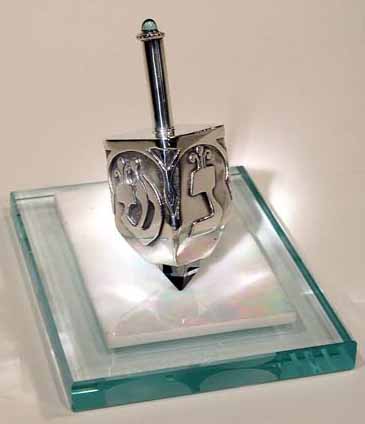
Hanukkah just wouldn't be complete without a dreidel, so here's one:


And here's another one:


And one more for good measure:


But of course, where there's a dreidel, there's also the "Dreidel Song," and so many different ways to sing it.  For example, you can croon it like Frank Sinatra, Tony Bennett, or good old Sammy Davis, Jr., as Kenny Ellis does here:


And you can do it up hip hop style like Erran Baron Cohen (brother of Sacha Baron Cohen) does:


And you can sing it a cappela, like the quartet Rockapella does in this amateur video (first few seconds on the footage is black):


And how about taking a look at some more dreidels, like this one:


And this one:


And this one here:


And have you ever heard anything like this electronica version of the dreidel song?


And have you ever heard the new lyrics added to the song, here performed in a traditional manner?


And can you imagine dreidels on Broadway?


So maybe you get the point that dreidels are really super:


Of course, you don't have to be Jewish to appreciate dreidels, as Don McClean of "American Pie" fame demonstrated with his Top 40 hit from 1972, "Dreidel":


 And you don't have to be Jewish to play the dreidel game, or enjoy Hanukkah, as this original "Dreidel Song" from Incubus makes crystal clear:


So, yeah,  
Get Your Dreidel On!  
And Happy Hanukkah!

Sunday, December 25, 2011

Light One Candle More

At this risk of some redundancy, since we posted this video during last year's Hanukkah celebration, here is "Light One Candle," written by Peter Yarrow, performed as a beautiful and moving live concert rendition, by Peter, Paul, and Mary:


This is very much a song about social consciousness, social justice, and social action, one of the great themes of the Jewish religious tradition.  And here are the lyrics:


Light one candle for the Maccabee children
With thanks that their light didn't die
Light one candle for the pain they endured
When their right to exist was denied
Light one candle for the terrible sacrifice
Justice and freedom demand
But light one candle for the wisdom to know
When the peacemaker's time is at hand

Don't let the light go out!
It's lasted for so many years!
Don't let the light go out!
Let it shine through our love and our tears.

Light one candle for the strength that we need
To never become our own foe
And light one candle for those who are suffering
Pain we learned so long ago
Light one candle for all we believe in
That anger not tear us apart
And light one candle to find us together
With peace as the song in our hearts

Don't let the light go out!
It's lasted for so many years!
Don't let the light go out!
Let it shine through our love and our tears.

What is the memory that's valued so highly
That we keep it alive in that flame?
What's the commitment to those who have died
That we cry out they've not died in vain?
We have come this far always believing
That justice would somehow prevail
This is the burden, this is the promise
This is why we will not fail!

Don't let the light go out!
It's lasted for so many years!
Don't let the light go out!
Let it shine through our love and our tears!
Don't let the light go out!

Let that message ring out loud and clear, during the Festival of Lights, and beyond:  


DON'T LET THE LIGHT GO OUT!


HAPPY HANUKKAH!