Showing posts with label Orthodox Judaism. Show all posts

Wednesday, October 4, 2017

Rabbi Schwartz's Sermon for Yom Kippur 5778


ISRAEL AT SEVENTY

YOM KIPPUR 5778

RABBI BARRY L. SCHWARTZ


On Rosh Hashanah I shared my concern about what is happening here, in the United States of America, in a sermon entitled, simply, My Country.

Now on Yom Kippur I want to share my concern with what is happening in my other country, the State of Israel.

When I say “My Other Country” it’s not simply because I happen to have dual citizenship, and the fact that my family of five has ten passports.

It’s not simply because I studied there, got married there, worked there, served in the army there… in fact all of that was many years ago when I was young, and yes, had a full head of hair.

It’s because I believe if you are Jewish Israel is your second home, your spiritual homeland if not your physical one.

It’s because I believe that if America is your mother and Israel is your father, you should love both your parents.

It’s because you are a citizen of the United States and you are a citizen of the Jewish people.

And it’s because America happens to be Israel’s best friend, and sometimes only friend.

As you know, Israel will soon celebrate its 70th birthday. So let’s begin with some positive, before we get to the negative. That’s a good approach to take with family. It’s helpful at any time, even more so before a big birthday.

Let’s remember that just seven decades ago, in the life span of many of you here, against all odds, a modern miracle arose in our ancient homeland.

As I’ve said before, “I am sorry that I was not alive in May of 1948 to witness this miracle. The ingathering of the exiles, the revival of a Jewish state, the rebirth of Hebrew: is there a more astounding event in all of Jewish history?

What a marvel and privilege, after twenty centuries, to be able to board an airplane and eleven hours later touch down in the holy land of a sovereign Jewish state.

As Daniel Gordis, an American rabbi who made aliyah wrote after witnessing a concert celebrating Jerusalem, during the height of the intifadah:

“An amazing thing⏤thousands of people out to celebrate a city. And it struck me. This country is an unmitigated success. It’s an achievement of cosmic proportions.”

Gordis goes on to list Israel’s many problems. Then he says: “But tonight, the music and the dancing remind us that those… can be fixed. Not long ago, though, there were things we couldn’t change. Without our own country, there was nothing we could do to help ourselves, to save ourselves.… This is not a population or a generation that will be scared into leaving or into despair. The hope of this place runs too deep… there’s a pulse to life here that cannot [be] killed. Who wouldn’t want to live in a place where even concerts are miracles?”

This spring there will be a lot to celebrate, and I hope we will do our part. Israel’s joy is our joy. Israel’s successes are our successes. Because the Israeli flag is also the banner of the Jewish people. It's no coincidence that the colors are blue and white. Those are the colors of the tallit⏤the traditional prayer shawl⏤which inspired the flag design. And the Jewish star in the center? That is the symbol not just of the nation, but of the Jewish people everywhere.


So if Israel’s joy is our joy, it also means that Israel’s sorrows are our sorrows.

And if Israel’s successes are our successes, then Israel’s failures are our failures, and Israel’s disappointments are our disappointments.

It was a rough summer. Let’s start with that. First there was the collapse of the Western Wall compromise. After years of negotiation to create an egalitarian prayer space next to the divided plaza of the Kotel, the Prime Minister pulled the rug out from under all those who had worked so hard on the plan. To add insult to injury he threw his support behind a bill that ensures that non-Orthodox conversions will never be recognized in Israel. It was all politics. The Prime Minister needs the ultra-Orthodox parties to stay in power.

Do you know that at the same time this was happening I performed a wedding here at the Temple for a daughter of this congregation, who was denied a legal marriage in Israel because she couldn’t prove that her grandmother’s conversion to Judaism was valid?

Do you know that I told the young couple that Debby and I were denied a legal marriage in Israel 36 years ago because we wanted to get married by a Reform rabbi on the grounds of the Reform seminary⏤the Hebrew Union College⏤in Jerusalem?

Israel at 70 is a remarkable place, but it is not an egalitarian, pluralistic place for non- Orthodox Jews… and that should concern us and trouble us.

In fact, earlier this year, at the urging of Norman Rosen, our Board of Trustees passed a resolution urging the Prime Minister to cease delaying the implementation of the Western Wall plan, which was brokered by Natan Sharansky. And after receiving an unsatisfactory reply, Norman wrote a strongly worded opinion piece in the Jewish Standard entitled “The Disgrace of the Western Wall”. It begins, “Imagine a place that is the holiest spot on earth for the Jewish people. Now imagine a place where peaceful worshippers are pushed and shoved, stones are thrown at them, and they are insulted, spit upon, and cursed. Sadly, the Western Wall… fits both descriptions."

We are proud Reform Jews. We have nothing to apologize for. Non-Orthodox Jews make up 90% of the American Jewish community and 60% of the Israeli Jewish community.

Seven decades after its founding, Israel should officially recognize all streams of Judaism.

Seven decades after its founding Israel should support Reform Judaism, Conservative Judaism and Reconstructionist Judaism.

Seven decades after its founding Israel should uphold religious marriage, civil marriage, and gay marriage.

As ARZA, the Association of Reform Zionists of America, commented, “Zionism… is premised on the idea of collective Jewish peoplehood as expressed by the Jewish state. Israel must remain true to its founding Zionist vision expressed in its Declaration of Independence: “Israel will ensure complete equality of social and political rights to all its inhabitants irrespective of religion, race or sex; it will guarantee freedom of religion, conscience, language, education and culture.”

Now as unfortunate as this inequality is within Israel’s borders, I believe that Israel at 70 faces an even greater problem with its occupation beyond its borders.

This past June marked the 50th anniversary of the Six Day War. One Israeli journalist has called that War the “cursed blessing”.

Blessing⏤because the Six Day War sent the unequivocal message to the world: We are strong; we can take care of ourselves; we are here to stay!

Curse⏤because the Six Day War resulted in Israel control of today more than 4 million Palestinians in the West Bank and Gaza.

Blessing⏤because Israel gained defensible borders, in the south with Egypt, in the north with Syria, and in the middle with Jordan.

Curse⏤because Israel’s borders are still unsafe with the rise of Hamas in Gaza, Hezbollah in Lebanon, and the Al Aqsa Brigade in the West Bank.

Blessing⏤because from Israel’s strength came the astonishing peace treaty with Anwar Sadat and Egypt; and with King Hussein and Jordan.

Curse⏤because the failure of a peace treaty with Arafat and then Abas has given Israel three intifadahs and endless strife in the territories, and fuel for the fire of a looming nuclear Iran.

The haunting question for Israel at 70 is how the Jewish State can remain democratic and Jewish while seven million Jews rule four million Muslims.

Can we continue to avoid this dilemma indefinitely?

I have said this before⏤unconditional love does not mean uncritical love.

You love your children unconditionally; that does not mean that you look away when you think they are wrong.

You speak up for their own sake; precisely because you care.

Israel is family. We have to be careful about criticism in public. We have to combat Israel’s enemies and naysayers. We have to say to the BDS movement⏤those who would boycott, divest, and sanction⏤you go too far; you are not fair or balanced or objective; you question Israel’s very right to exist, don’t you?

We need to love Israel. We need to stand with Israel.

We need to visit Israel. We need to lobby for Israel. We need to praise Israel.

We need to celebrate with Israel in this milestone year.

And we need to work for a more just Israel, inside and out.

In the words of the ancient prophet:

“For the sake of Zion I shall not remain silent… until her righteousness shines like the dawn and her triumph like a flaming torch.”

Sunday, March 12, 2017

Politics and Religion

 From the pages of Kadima, the newsletter of Congregation Adas Emuno:


A Message From Our President


Dr. Lance Strate


Politics and Religion


It used to be said that you should never talk about religion or politics, at least not in polite society, or mixed company. And maybe many still consider it rude to do so. Of course, these are topics that were never entirely taboo, but rather reserved for private conversation among intimate associates, confederates, that is to say, like-minded individuals.

Of course, within the confines of our houses of worship, congregants have no compunctions about engaging in conversation on the topic of religion. As Rabbi Schwartz has so eloquently explained, discussion and debate for the sake of heaven is central to the Jewish tradition. And anyone familiar with Jewish culture would find it hard to imagine us refraining from voicing opinions on matters of mutual concern.

But the rule regarding politics is another matter entirely. Members of our shul who share the same religious heritage may differ significantly in their political views, and the clergy and temple leadership generally try to respect those differences. We do not want the temporal issues that may divide us to overshadow the essential, ancient, spiritual relationships that bind us together with one another.

At the same time, as a religion, we are asked to adhere to a set of moral and ethical standards, and to speak out when they are violated. Leviticus (19:16) famously admonishes us, "do not stand idly by while your neighbor's blood is shed." And our tradition also includes the Kabbalistic notion of tikkun olam, the repair or healing of the world, as our central obligation. This is a precept that has become central for the Reform movement that we are a part of (a movement that is sometimes also referred to as Liberal or Progressive Judaism).

And we well recall the words of Hillel, "If I am not for myself, who will be for me? But if I am only for myself, who am I? And if not now, when?" We recognize that Hillel's three sayings represent a call to stand up for ourselves and our principles, to seek justice and compassion for others, and as a call to action.

Last year, one of our Trustees, Norman Rosen, voiced his concern over the way that the Israeli government has handled egalitarian worship at the Kotel, the Western Wall, which represents the holiest site in Judaism. This is a longstanding controversy, and the Reform movement has been especially supportive of and involved in the Women of the Wall movement. The Knesset approved a compromise regarding the site, which has been under Orthodox control, but the Israeli government has failed to enforce the compromise.

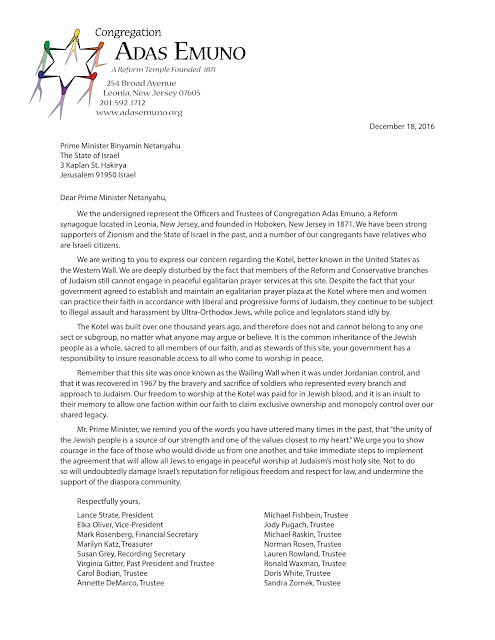
Norm was deeply disturbed by what he had witnessed firsthand at the Wall, and asked the Board of Trustees to send a message to Prime Minister Benjamin Netanyahu. Following in-depth discussion by the board members and clergy, the proposal was approved, a letter was drafted, signed by the vast majority of the board, and delivered to the Prime Minister's office. [Editor's note: See out previous post,
Our Letter to Netanyahu.] No reply has been forthcoming so far, long delays are commonplace, but the Jewish Standard will be publishing an article based on Norm's experiences that led to this effort.

Equal rights for women is, of course, a political issue, as is Israel's governmental policy regarding administration of the Temple mount. But the subject of our letter is also a religious issue, and the Reform, Conservative, and Reconstructionist branches of Judaism have long been fighting for official recognition by the Israeli government, for example in regard to marriage, conversion, etc., and egalitarian worship at the Wall is another issue that directly concerns our standing and legitimacy in the Jewish state. In this instance, we are standing up for ourselves as much as for others. If I am not for myself, who will be for me?

At our February board meeting, Rabbi Schwartz brought to the board a resolution crafted by Leonia's interfaith clergy in response to Donald Trump's January 27th executive order that barred people from 7 Muslim-majority countries from entering the US, and stopped all refugee admissions. In addition to criticizing the ban, the resolution asks the Borough of Leonia's Council to designate Leonia as a sanctuary city. Just as his colleagues were doing with their own church leaders, our rabbi asked the board if we would sign onto the resolution on behalf of our congregation.

An in-depth discussion of the legal and moral considerations ensued, followed by a vote in which the rabbi's request was approved by a supermajority of over ¾ of the board members present. This was a rare instance in which the board was asked to take a stand on a political issue, and most felt that the actions of the government were so extreme as to merit making a statement, even if it is only symbolic. If I am only for myself, who am I?

One of the questions that came up in our discussions was whether getting involved in any kind of political issue would endanger our 501(c)(3) tax exempt status. Here is the explanation that board member Michael Fishbein provided: "The activity that could jeopardize tax exemption is essentially taking sides against or in favor of a particular candidate during an election. Commenting on social issues or issues of human freedom is not barred. So, for example we could advocate in favor of gay marriage, just as another religious organization can advocate against gay marriage. However, we cannot endorse a particular candidate because he or she is pro gay marriage."

Personally, I usually favor having our congregation avoid political controversies, whether it has to do with Israel or the US. What makes any given topic an issue is the fact that there are pros and cons, reasons for and against. Not everything is an issue for that reason. No one is really pro-illness for example, or pro-poverty. But there are reasons why some favor apply Orthodox strictures to the Kotel, and a strict ban on immigration to the US.

But there are times when it is difficult to stand idly by, and I believe that these two instances are exceptions to the rule about not speaking out when it comes to politics and the polite company of our congregation. They are two instances in which the board felt it important to stand up for ourselves, to stand up for others, and to take action and make a statement. If not now, when?


Saturday, February 25, 2017

Our Letter to Netanyahu

This past fall, Trustee Norm Rosen brought up the issue of egalitarian prayer at the Western Wall, or Kotel, to the Board. For more about the controversy, see the following article from the Forward website: With Western Wall Prayer Deal Dead, Orthodox Stake Brazen Claim to Egalitarian Area.

After much discussion, a letter was drafted, revised, signed by the officers and all but one of the Trustees of Congregation Adas Emuno, and delivered (via the internet) to the Prime Minister of the State of Israel, Benjamin Netanyahu.

As we consider this an open letter as well, we are sharing it here on our Congregational blog:


Wednesday, October 5, 2016

Rabbi Schwartz's Sermon for Rosh Hashanah Evening 5777


AVINU MALKEINU


ROSH HASHANAH 5777

RABBI BARRY L. SCHWARTZ


Rosh Hashanah is a time when we celebrate the past even as we embrace the future. We mark the arrival of the High Holy Days by honoring the old while welcoming the new. We chant ancient words, but often add new melody and translation.

This Rosh Hashanah I would like to partake of the old/new by starting a new tradition. Now, on the eve of the Holiday, rather than giving a sermon on contemporary matters, I would like to offer a Davar Torah, a commentary, on one of the key prayers in our holiday liturgy.

After all, we recite these prayers year and year, sometimes by rote. They form the backbone of our service. They move us in an emotive, nostalgic way… but what do they mean? What are we saying? Why are they important?

I am going to start with perhaps the best known prayer of the High Holy Daysthe Avinu Malkeinu. (That is why I am delivering these words now
before we recite the prayer, rather than the usual spot afterwards). And as you will see in a few moments, I will have some help.

That is because my commentary will include some creative interpretations of the Avinu Malkeinu from the new Reform machzor, called Mishkan Hanefesh, which was published just last year. It is a beautifully produced two volume set, and expensive, and it is unlikely we will purchase it anytime soon. But I want to introduce some of its best new material into our service, and this is one way to do it.

We know that the oldest surviving prayer book, Seder Rav Amram, which dates to the 9th century in Babylonia contains the Avinu Malkeinu. So Jews have been reciting this prayer for at least a thousand years. But the original phrase, Avinu Malkeinu, Our Father, Our King, is known from a Talmudic tale of Rabbi Akiba, who died around 132 during the Second Revolt against Rome. So Jews have addressed God in this way for almost 2000 years.

This prayer obviously has staying power, and star power. It remains the centerpiece of the High Holy Day liturgy before the open ark. It has been set to so many stirring melodies. But as Professor Lawrence Hoffman, a leading authority of Jewish liturgy, and one of my rabbinical school professors, notes, “The music... so overwhelms the lyrics that most people remain relatively unconcerned with what it means.” While that is not a tragedy, it behooves us to consider the content of what we are saying, or rather, praying. And as we will see, how to properly translate and understand Aveinu Malkeinu is a challenge.


. . . . . . . . . . . . . . . . . . . . . . . . 


Another scholar, Richard Saranson, writes that, 


It is an irony of history that the very language now so controversial in Avinu Malkeinu (namely the masculine-gendered, hierarchical images of God as "Father" and "King") is what make this prayerful appeal so distinctive and effective for its original users.

Avinu Malkeinu, Rabbi Saranson, goes on to say, 


is a penitential litany.  That means that it uses the...  refrain, "Our Father, Our King," repeatedly to invoke the gracious favor of a God who is conceived of as both distant and approachable, both stern and merciful; whose powerful nature can be portrayed as both Ruler and Parent toward the people Israel, who view themselves during the High Holy Day season as both dependent and unworthy of favor–"Deal with us graciously for Your own sake, since we can plead little merit before You." Encapsulated here are the ambivalent feelings of we mortals toward the power in the world outside us over which we have uncertain or little control.

The story in the Talmud tells of Rabbi Akiva stepping before the ark during a great drought and exclaiming, Our Father, our King! We have no king but You! Our Father, our King! For Your sake, have compassion for us! And then the rain fell. (Babylonian Talmud, Ta’anit 25b)

Over time the number of petitions for God’s compassionate care grew and grew. For example:

Our Father, our King! Deal with us [graciously] for Your name’s sake!

Our Father, our King! Send a complete healing to the sick among Your people!

Our Father, our King! Remove from us plague, sword, famine, and destruction!

Our Father, our King! Remember that we are but dust and ashes!

Our Father, our King! Speedily bring us salvation!

In the traditional Ashkenazic rite there are forty-four such petitions!  Most Reform prayer books have reduced that number significantly. For those of us who remember the old Union Prayer Book there were only seven. Reform reduced the number of petitions for reasons of length and because the strong penitential rhetoric of some of these petitions did not sit well with a modern sense of human empowerment.  Gates of Repentance, which we use, brings back more of the Avinu Malkeinu petitions, and concludes with the one that pleads our lack of merit. Why? That last line is commonly sung to a well-known eastern European melody, which we use too, and thereby has come to typify the entire litany for many American Jews.

While earlier generations of Reform Jews had difficulty with praying that we have no merit, our generation has also had trouble with the Avinu Malkeinu’s masculine and hierarchical images of God. You might say that it is no longer politically correct to use such language. Already in 1996 the new gender-sensitive edition of Gates of Repentance included at the back of the book a feminized version of the prayer. But for many, substituting parent for father, and ruler or monarch, for king, takes away from the power of the prayer. It has led to quite a debate, and in the end the new Reform machzor leaves the key phrase untranslated. How’s that for ducking the issue?

A final point before the interpretative readings. As Rabbi Barry Block write in sermon about this prayer a few years ago: "Calling God Avinu and Malkeinu, in the same breath, is an oxymoron." A parent is not a monarch, and "does not rule with strict justice." A ruler, on the other hand,


cannot remit penalties out of loving favor....
The one, true God is two opposite thingsAvinu, a loving parent, and Malkeinu, a strict rulerat one and the same time. God is a living, divine oxymoron. God seeks to love. God needs to judge.
The ancient rabbis teach that both strict justice and divine love are required to establish and sustain creation….
So what do we need God to be, at this High Holy Day season, Avinu or Malkeinu?


Sunday, August 2, 2015

Jewish Life in Colonial America

We're grateful to Cantor Sandy Horowitz for sharing with us the sermon she delivered on Friday evening July 3rd, the eve of the Shabbat that coincided with America's Independence Day:


July 3, 2015

Since it’s almost July 4th and we are in a synagogue, I thought I would spend a few minutes talking about the Jews who first came to this country before the Revolutionary War. 
Jews in Colonial America were certainly free of the overt persecutions and forced conversions to Christianity that had been their experience in Europe; however they weren’t exactly free to live on an equal basis with their Protestant counterparts. (Nor for that matter were the Catholics.) 

The first group of North American Jews landed in New York–then known as Dutch New Amsterdam –arrived in 1654. There were 23 of them, primarily traders and merchants, and they came from Brazil after having fled persecution in Europe.

Since New Amsterdam was Dutch, and Holland was known for its religious tolerance, these Jews figured they had it made. Unfortunately, Governor Peter Stuyvesant didn’t see it that way; he didn’t want Jews to settle in his colony. But economics prevailed over prejudice, as the Dutch West India Company was interested in these Jewish traders, and effectively convinced Stuyvesant to let them stay.

And so they were allowed to trade and to own real estate. However they were not permitted to hold public office, open a retail shop, or establish a synagogue.

When in 1664 the English captured New Amsterdam from the Dutch and renamed it New York, life for the Jews remained essentially the same. 

As public worship was seen as a threat to the Protestant way of life and was therefore forbidden, Jews prayed privately in a mill loft, which they made into a makeshift synagogue.

For those of you who heard Rabbi Schwartz speak last week about the history of Charleston's African Methodist Episcopal church, we recall that just as Jews prayed privately and in secret in colonial times, so too–in a far more violent climate–did our southern African-American counterparts find ways to pray together even when it was forbidden. 

In any case, the mill loft was the precursor to the first publicly known synagogue Shearith Israel, which was consecrated around 1720, and which exists as a congregation to this day. But I’m getting ahead of myself.

So, what was Jewish religious life like during this time? These were Sephardic Jews, and for the most part they maintained their Orthodox religious observance. Remember, the Reform and Conservative movements didn’t exist yet. However, once in America, there was a relaxation of observance among some at least, when it came to dietary laws and keeping the Sabbath. It’s known for example that Jews served in the army during the Revolution, where they certainly would have not kept kosher or observed Shabbat.

What’s more, during this time, Colonial Jews chose not to import ordained Rabbis from Europe, as their sister congregations in the Caribbean and South America had done. And so there was no one whose role was to decide on matters of ritual law (halakha), make sure people kept kosher, or be a model for Jewish scholarship and learning. This didn’t change until the 1830s. When disputes arose, unlike the European model where issues were resolved within the Jewish community, here in the colonies, Jews like everyone else relied on civil authority. This was new.
So–who led the congregations in worship? It was the Cantor, known as the Hazzan-Minister.

In fact, the area where the colonial Jewish community was most strict about adherence to tradition, was with its music–Torah cantillation and their liturgical melodies. And so they did import trained cantors–hazzanim–from Amsterdam and London.

Along comes the Revolutionary War. When the British army advanced into New York, most of the members of Shearith Israel, who sided with the rebels, took their Torahs and fled first to Connecticut and four years later, to Philadelphia where they founded a new synagogue, Mikveh Israel. Meanwhile, some members of Shearith Israel, who were loyal to England, remained in New York. Here we may have just witnessed the first congregational ideological split.

Shearith Israel congregation still exists today: to borrow from Guys and Dolls, it’s the “oldest established permanent floating synagogue” in New York. It floated up from its first home on Mill Street downtown to the upper west side where it’s an active synagogue today. 

So that’s New York, what about the Jews of New Jersey? Although it wasn’t until the mid 1800s that there were known established Jewish communities, Jewish merchants from New York and Philadelphia did conduct business in New Jersey during the colonial period. Among the first Jewish settlers were Aaron and Jacob Lozada, who owned a grocery and hardware store in Bound Brook as early as 1718. Daniel Nunez appears in a 1722 court record as town clerk and tax collector for Piscataway Township and justice of the peace for Middlesex County. This may be earlier than their New York counterparts would have been allowed to hold civic office.

In any case, it was the war that led to a change in status of American Jews. 

As I mentioned, Jews for the most part sided with the rebels; they signed non-import agreements, promising not to trade with the England, and many enlisted in the Continental Army and the various militias. They served as soldiers and in some cases as officers. Some Jewish merchants also made significant financial contributions to the revolutionary war cause. After the war, George Washington as President wrote to several of the Jewish congregations thanking them for their contributions and their service.

Over time, the newly formed states loosened their policies regarding the restriction of voting to Protestants only, and by the early 1800s Jews were given the right to vote–(Jewish men, that is…).
We had it easy compared to our African-American counterparts, who didn’t get the vote until much later, and who had a far more violent history than we ever did in this country. But our colonial American history should serve as a reminder that we too have had to struggle for equal treatment under the law even here, in the land of freedom whose birth we celebrate this weekend. 

In a 1790 letter to the Newport Rhode Island Congregation, George Washington wrote: "May the children of the stock of Abraham, who dwell in this land, continue to merit and enjoy the good will of the other inhabitants, while everyone shall sit safely under his own vine and fig tree and there shall be none to make him afraid. [Michah]" 

May this beautiful image one day come true for all Americans, and may we help to make it happen.

Shabbat shalom.


Wednesday, April 1, 2015

Leonard Nimoy and Mr. Spock

The March 6th issue of the Jewish Standard included another op-ed by Adas Emuno president Lance Strate, in conjunction with the recent passing of actor Leonard Nimoy, best known for his portrayal of Mr. Spock on the Star Trek television series and motion pictures. Appearing under the title of Live Long and Prosper, with "Leonard Nimoy and Mr. Spock" as the subtitle, the piece goes like this:


The death of Leonard Nimoy on Friday, February 27, at 83, marked the passing of an American icon—indeed, a star of global renown, and a Jewish hero as well.


Nimoy’s accomplishments were many. He was an author, poet, musician, photographer, philanthropist, educator, and director, and of course an actor who played many roles on stage and screen. But he is best known for his role as Mr. Spock on Star Trek, the television series that first aired in 1966. It is a role he reprised in the various sequels, spinoffs, and remakes that appeared after the original series went off the air in 1969.

Nimoy was a Boston native, fluent in Yiddish, whose parents were Orthodox Jews who escaped from the Soviet Union. As he related in various interviews, his background informed his portrayal of the sole alien being on the Starship Enterprise. Spock hailed from the planet Vulcan but was also half-human, making him an alien on Vulcan as well. His status reflects that of immigrants and their children, first-generation Americans who, like Nimoy, grow up in a household, community, and culture that still has one foot in the old world.

As a child attending Orthodox services, Nimoy observed the Cohenim delivering the priestly benediction, and as an adult he appropriated their hand gesture when he introduced the Vulcan salute. The greeting that he added to the salute, “live long and prosper,” echoes the sentiment of the benediction, as well as the simple greeting “shalom” (further echoed in the ritual response, “peace and long life”). There is certainly cause for pride in this small Jewish contribution to global popular culture, but does this mean that Star Trek incorporates Jewish undertones, as Haaretz writer Nathan Abrams insisted in an article published the day after Nimoy’s death? Certainly, Jewish fans can take pleasure in the fact that Nimoy and co-star William Shatner are Jewish. So were several of the series’ writers, and we can assume that they all brought some elements of a Jewish sensibility to the program.


But let’s be clear that Star Trek was created by Gene Roddenberry, who was not Jewish, and who included characters from a variety of different backgrounds—Scottish, Irish, French, Italian, Russian, Japanese, and African—but never one who was identifiably Jewish. Indeed, the only characters with any real Jewish identity in the Star Trek universe appeared in a few of the many original novels published under license from Paramount Pictures. No doubt this is not because of any bias or prejudice on Roddenberry’s part, but rather because he associated Jewishness with religion, rather than nationality. His vision of the future was one in which science and progress reigned supreme, and any seemingly supernatural phenomena would inevitably be revealed to be a product of a highly advanced science, or biological evolution.

The conspicuous absence of any Jewish characters from Roddenberry’s melting-pot future can lead viewers to search for them in disguised, symbolic form, to look for what Sigmund Freud referred to as the return of the repressed. And the obvious form for a crypto-Judaic character to take would be that of an alien being. Indeed, while Shatner had the kind of looks that allowed him to pass as a WASP from Iowa, Nimoy’s features gave him what was considered at the time to be a relatively interchangeable “ethnic” appearance, so that earlier in his career he played Spanish, Mexican, and Native American characters. And certainly there are Jewish elements incorporated into Nimoy’s man from Vulcan, and into other aspects of Star Trek. Consider the episode called “Patterns of Force,” in which an alien planet patterns itself after Earth’s Nazi Germany, and is trying to wipe out their neighboring planet, called Zeon (an obvious reference to Zion).

But I want to suggest that Abrams and others are wrong about Spock being implicitly Jewish. It perhaps is revealing that Abrams mistakenly refers to the character as “Dr.” Spock, a mistake not uncommon among those not very familiar with the series. Nimoy’s character usually is referred to as “Mr.” Spock, in keeping with naval tradition about first officers, and occasionally by his rank, which was at various times commander, captain, and ambassador. Dr. Spock was, of course, Benjamin Spock, the famous pediatrician whose bestselling book, Baby and Child Care, served as a bible to the parents in the postwar era. Like Roddenbery, Dr. Spock was not Jewish. The name Spock is Dutch, originally spelled Spaak.


Spock’s home planet, Vulcan is named for the Roman god of fires and forges, and Vulcans are revealed to be related to another alien race, the warlike Romulans, named for the founder of Rome. Vulcan philosophy, which venerates logic above all else, represents a view that is very much in keeping with Athens rather than Jerusalem. Vulcans revere Surak as the founder of their philosophy. Surak has little in common with Moses but quite a bit with Socrates, with some Gandhi thrown in for good measure. So while Spock’s home planet is depicted as having the kind of hot, dessert-like climate that we associate with the Middle East, the stronger connection is to the European side of the Mediterranean.

Abrams associates Vulcan intellectualism with the people of the book, but the aliens do not seek a balance between faith and reason, in the fashion of Maimonides, but rather enforce a strict discipline, suppressing all emotion, in a way that is very much in keeping with another branch of ancient Greek philosophy, Zeno’s Stoicism. Moreover, suppression of emotions often is linked to dehumanization, as a means of forcing individuals to adapt to mechanization and industrialism, yielding a technological being well suited to being a cog in a machine, rather than a mensch, a real, well rounded human being. We may therefore identify with Spock’s struggles, and admire his superior physical and mental abilities, but it is his human side that is the most Jewish part of him.

Following a long tradition in western culture, Roddenberry used orientalism to convey a sense of the alien, and this includes Jewish as well as Arabic, Persian, and Chinese elements. With his raised eyebrows, Spock bears a certain similarity to Ming the Merciless, the alien villain from the old Flash Gordon serials. But it was not until long after Roddenberry’s death in 1991 that a Jewish film director, J. J. Abrams, who was recruited to reboot the series, invokes the destruction of the Temple and subsequent diaspora by having the planet Vulcan destroyed by Romulans. In that 2009 film, called simply Star Trek, time travel is used to generate an alternate timeline, and Leonard Nimoy makes a cameo appearance as the original, now-elderly Spock, while Zachary Quinto takes on the main role as the new Spock. (Quinto is of Italian ancestry, and Italians and Jews often have been cast interchangeably in film and television.) Nimoy’s final film appearance was in the 2013 sequel, Star Trek Into Darkness, also directed by Abrams.


As a science fiction fan, I can appreciate Star Trek in all of its iterations, and I can enjoy it as a form of American entertainment and popular culture without exaggerating its Jewish undertones. And as a Jewish-American, I can feel pride and affection toward Leonard Nimoy, as a landsman, as the producer and star of the TV movie about a Holocaust survivor, Never Forget, as the author of the photography book Shekhinawith its erotic Kabbalistic theme, and as the originator of the Vulcan salute and the saying “Live long and prosper.”


Sunday, May 4, 2014

The Rabbi’s Top 10 Jewish Modern Events

This past Monday, April 28th, was Yom HaShoah, Holocaust Remembrance Day, this coming Monday, May 5th, tomorrow that is, will be Yom HaZikaron, Israel's Memorial Day, and the day after that, Tuesday, May 6th, will be Yom HaAtzma'ut, Israel's Independence Day.

In honor of this sequence of highly significant commemorations, we are pleased to repost here on our blog Rabbi Schwartz's list of the ten most important modern Jewish events, which originally was published on April 24th in his online column for the Times of Israel, under the heading of The Rabbi’s Top 10 Jewish Modern Events:


As we approach Yom HaShoah, Holocaust Remembrance Day, I offer a history list – my compilation of the most consequential events of modern Jewish history. As always, I welcome your comments.

1. Spinoza’s Excommunication—Launched thinker’s epic contribution to “modernity” and the notion of the secular Jew.

2. Mendelssohn’s “Jerusalem”First modern attempt to reconcile faith and reason.

3. Rise of HasidismKabbalistic spirit becomes energizing movement.

4. Parisian SanhedrinChallenges of citizenship become evident.

5. Frankfort Rabbinical ConferenceReform of Judaism finds its place even as a backlash ensues that helps create Conservative and Modern Orthodox denominations.

6. Emigration to AmericaDemographic shift begins to the new world.

7. Dreyfuss TrialPersistence of anti-Semitism shook Herzl and Europe.

8. First Zionist CongressHerzl’s reply and the first achievement of modern Zionism.

9. HolocaustTragedy on an unimaginable scale.

10. Birth of Modern IsraelTriumph on an unimaginable scale.

Previous posts in this series include The Rabbi’s Top Ten: The Best of Everything Jewish, and The Rabbi’s Top 10 Jewish Foods

Sunday, February 23, 2014

A Congregant's Thoughts on Genesis

Once again, congregant Ludwik Kowalski has asked that we share his thoughts regarding our weekly Saturday morning Torah study sessions. This year we have been concentrating on family narratives in the Torah and Tanach, and these remarks come in response to last week's (February 15) discussion regarding Jacob.
We are still discussing Genesis. Last week congregant Eric Fisher said that Abraham, Jacob, Rebecca and Leah are our ancestors. Today I objected, saying that they are not real people, that we have no historical evidence of their existence. Then I quoted the following statement from our prayerbook (on page 33):
Torah is what God revealed to us, and what we discern of God; ideas, ideals, laws and mitzvot, our religious heritage.
God, as I often repeat, is a spiritual (not material) entity. The same applies to people and events described in the Bible. Spiritual entities are not real; they are fictitious. I am a scientist. How do I reconcile my scientific attitude with my belief in God? By accepting the NOMA position, formulated by another scientist, Stephen J. Gould. According to Gould, science and theology are two non-overlapping magisteria. Methods of validation of spiritual claims and methods of validation of material claims are drastically different. My elaboration on this topic was published one year ago at on my website.
"God is not a material entity," I wrote, "and attempts to refute God's existence by performing scientific experiments are not appropriate. The same is true for attempts to refute scientific claims, such as the age of the earth, on the basis of disagreements with holy books." Here are other terms used to describe the two non-overlapping magisteria:
  • natural versus supernatural
  • physical versus metaphysical
  • real versus fictional
  • objective versus subjective
  • materialistic versus idealistic
  • etc.
Adjectives such as mystical, metaphorical, allegorical, and assumed, are often used to describe our spiritual world entities. Today I asked our rabbi what he thinks about Eric's statement. He said that we are studying God-inspired descriptions of beliefs of our sages. In other words, unlike many Orthodox Jews, we do not take these descriptions literally. This is consistent with what our rabbi wrote in his book entitled Judaism's Great Debates, published in 2012, and with what was written by the German rabbi Abraham Geiger, one of the founding fathers of Reform Judaism, in the 19th century.
Ludwik Kowalski's views, as they are expressed here, do not necessarily represent the official position of Congregation Adas Emuno. But we are always happy to share the thoughts and opinions of our members here on our congregational blog.

Sunday, March 31, 2013

Passover and Plato

The following is a repost from my own blog that is relevant to the discussions of Judaism and Greek philosophy that have come up repeatedly in this year's Torah study, with its focus on Maimonides. In this instance, it's not the contrast between Athens and Jerusalem that is emphasized, but the commonality of the two worldviews, both with roots in the first truly literate cultures of antiquity. 

The post involves a response to another blog post by Rabbi Dr. Nathan Lopes Cardozo of the David Cardozo Academy in Jerusalem, and while the Academy and Rabbi Cardozo are Orthodox in orientation, the conclusion has much relevance for Reform Judaism in the 21st century.

And the post is relevant as well to the 4,000 year old Pesach festival that we have been observing over this past week:  


Apart from its other potential benefits in areas such as ethics and spirituality, religion can lead to important insights associated with a media ecology perspective.   

For example, in Amusing Ourselves to Death, Neil Postman mentions how he learned about the Ten Commandments of Moses as a child, presumably in Hebrew School, and was particularly taken with the Second Commandment's prohibition against graven images of any kind, independent of their content, which in practical terms can be said to be the first historical expression of a media ecology approach.  

For Walter Ong, as a Jesuit priest learning about religious traditions, he explains how a big breakthrough came for him when he realized that the emphasis on the visual sense, which has it roots in the literate culture of ancient Greece, is not present in the literate culture of ancient Israel, and that a high degree of residual orality persists in Jewish religious tradition, to this day. The visualism that first started to coalesce in Greece and Rome did not fully come to dominant western culture until after the printing revolution begun in the 15th century, but from that point on, it is integral to all that is, or was, distinctive about modern western culture.  

Now, Ong and Postman, along with other media ecology scholars such as Marshall McLuhan, have identified Plato's Phaedrus  as including the first form of scholarship in the field of media ecology, insofar as that dialogue includes some discussion of the differences between speech and writing as modes of communication. That discussion is supplemented by further observation in Plato's Seventh Letter

  So now, with all that in mind, I was particularly interested to see a blog post entitled Plato, the Haggada and the Art of Reading written by Rabbi Dr. Nathan Lopes Cardozo of the David Cardozo Academy in Jerusalem. The post appeared on March 14, in advance of the Passover holiday, and begins like this:
 
Now that Jews all over the world will once again assemble around the Seder table and read the Haggada—the story of the exodus from Egypt—it may be worthwhile to put some thought into the art of reading.
In The Phaedrus (275a-278a) and in his Seventh Letter (344c), Plato questioned—and in fact attacked—the written word as being completely inadequate. This may explain why philosophers have scarcely written about the art of writing, although they extensively engaged in that very craft!
It is well known that Plato used to write in the form of dialogues, and it is clear to anyone reading these conversations that his main purpose in doing so was to hide the characteristics of the texts. He worked for years on polishing this literary form. Cicero maintains that Plato actually died at his writing table at the age of eighty one. “Plato uno et octogesimo anno scribens est mortuus.” (1)
 
The footnote reads: "Cicero, 'On Old Age,' Section 5." And let me note at this point that within the dialogue, it is Socrates who takes this position, and there is at least some question as to whether these are arguments made by Socrates, who left us no written works and appears to us as a champion of orality. Is Plato a reporter, in this sense, relating what Socrates said, or is Socrates just a literary character, a mouthpiece for Plato's own thought? Whether the truth lies more in one direction or another, we can assume that the concerns expressed were those of Plato, but also note the irony that he did in fact put them into writing, or else we would never have known about them.  

Okay, back to Rabbi Cardozo...
 
What bothered Plato was that he believed the written word would fall prey to evil or incompetent readers who would do anything they want with the text, leaving the writer unable to defend or explain himself. He feared the text would take on a life of its own, independent of its author, as is indeed characteristic of the written word. Even more interesting is his observation that a written text actually becomes a “pharmakon”—a drug that can either heal or kill, depending on how it is applied. It may even be used as a prompt, but will ultimately lead to memory loss since it will make the brain idle. Years later, Immanuel Kant wrote along similar lines, saying that the “script” wreaked havoc on the “body of memory.” (2)
 
This second footnote reads: "Immanuel Kant, Anthropologie in Pragmatischer Hinsicht, Suhrkamp, STW 193, Frankfurt am Main, p 489-490." The point about memory is well-taken, of course, and speaks to the fundamental notion of use it or lose it. But beyond memory is the gradual erosion and loss of mnemotechy, of mnemonic techniques that were developed in oral cultures, and continued to be used and supplemented in scribal cultures. That's on the technical side, but Rabbi Cardozo points to a different aspect of memory:
 
However, according to Plato, this means far more than just losing information, or being deprived of the skill of memorizing. For him, real knowledge was a matter of “intrinsic understanding,” demanding a person’s total presence within what he reads or says. Only that with which I totally identify and which has become united with my Self can be called knowledge and is in-scribed in my whole personality. That which I have simply read or learned superficially is not really knowledge.
 
This is an important point as well.   We learn, memorize, internalize with our whole body. Ong refers to the Jesuit scholar Marcel Jousse who used the term "verbomotor lifestyle" to refer to this involvement of the whole body. In Jewish tradition, in praying and also in studying Talmud (which Ong mentions), individuals daven, a Hebrew word with the connotation of rocking back and forth, although the denotative meaning is pray. One of our most important prayers, the V'Ahavta (which comes from the book of Deuteronomy) begins with, "And you shall love the Lord your God with all your heart, and with all your soul, and with all your might." In other words, with complete involvement of body, mind, and spirit. And getting back to the point about memory, McLuhan's colleague, Edmund Carpenter, noted that we use the phrase, learning by heart, where heart is a metaphor for the body—it's not just a mental activity.  

Alright then, it's time now for Rabbi Cardozo to apply this understanding to the Jewish observance of Passover:
 
Unwittingly, Plato touched on a most fundamental aspect of the Jewish Tradition. We Jews are called “the people of the book.” But we are not; we are the people of the ear. The Torah is not to be read, but rather is to be heard. It was not written in the conventional sense. It was the Divine word spoken at Sinai, which had to be heard and which afterwards, out of pure necessity, became frozen in a text, but with the sole intention of being immediately “defrosted” through the art of hearing. This, then, became the great foundation of the Jewish Oral Tradition. 

This brings up some interesting points about what went on with God and Moses according to the Torah. My understanding is that God wrote the Torah down on stone tablets, typically depicted as the Ten Commandments, but the Torah has 613 laws all told, plus the narrative that makes up the Five Books of Moses. Traditionally, it's said that the entire Torah was delivered in this way, but whatever it consisted of, the story has it that Moses threw the tablets down when he saw the Israelites worshiping the golden calf, so that they were broken into fragments, then went back up the mount, and the second time around God dictated them and Moses wrote them down in his own hand.  

But there's more! By the time of the Roman conquest of Judah, which they renamed Judea, there were two groups vying for dominance . One, the Sadducees, who were members of the upper class, including the priests who controlled the Second Temple, only acknowledged the written law as found in the Torah as a document. The other group was the Pharisees, from whom Rabbinic Judaism emerged, and who have been unfairly maligned within the Christian New Testament (especially given the fact that much of what Jesus says in the New Testament is essentially an extreme Pharisaic position). The Pharisees argued that in addition to the written Torah, God also gave Moses the oral Torah, which is the tradition of oral interpretation of the written text. This allowed for much greater flexibility, and from this comes the document known as the Talmud, which is a written record of that oral tradition. 
   
But note that it is an oral tradition quite different from the oral tradition we associate with oral cultures, but rather an oral tradition that responds to a written text. The answer to Plato's criticism that a text cannot answer questions is this act of interpretation. That is the role of the teacher, and that is what is meant by a rabbi, or in eastern tradition a guru, someone who can speak for, answer for, and interpret a text.  

All right now, let's return to Rabbi Cardozo and the distinction between seeing and hearing:
 
Reading entails using one’s eyes and, as such, the act remains external. The words are not carved into the very soul of the reader. Rabbi Yaakov Leiner, son of the famous Ishbitzer Rebbe, Rabbi Mordechai Yosef Leiner, and one of the keenest minds in the Chassidic tradition, speaks about seeing. He makes the valuable observation that sight discloses the external aspect of things while hearing reveals the internal. (3) One must hear a text, not read it. This is the reason why the body of Torah consists of minimum words and maximum oral interpretation.

Footnote 3 reads: "Rabbi Yaacov Leiner, Beis Yaakov: Rosh Chodesh Av." And this is a very important point. Vision gives us exteriors. Voice comes from inside us, with the breath of life, so that the interior is exteriorized, and then internalized again through the act of hearing.  


Now, let's return to Rabbi Cardozo and the question of the Talmud as oral tradition:
 
Still, does the open-endedness of the Torah not present the opportunity for anyone to read his own thoughts into the text and violate its very spirit? The Jewish Tradition responded to this challenge with great profundity. It created an ongoing oral tradition in which unwritten rules of interpretation were handed down, thereby securing the inner meaning of the text while at the same time allowing the student to use all of his creative imagination. Even after the Oral Torah was written down in the form of the Talmud, it remained unwritten, as any Talmud student can testify. No other text is so succinct and “understaffed” in written words while simultaneously given to such vast interpretation. The fact that the art of reading the Talmud can only be learned through a teacher–student relationship, and not merely through the written word, proves our point. Only when the student hears his master’s oral interpretation of the text is he able to read it, because the teacher will not only give him explanations but will also convey the inner vibrations that were once heard at the revelation on Mount Sinai. This is the deeper knowledge that the teacher received from his masters, taking him all the way back to the supreme moment at Sinai. In that way, the student can free himself from a mechanical approach to the text. He will hear new voices in the old text, without deviating from its inner meaning. This will give him the courage to think on his own and rid himself of prejudice. The text, then, is not read but heard.

Given our visualist tradition in the west, we tend to assume that reading means reading silently to ourselves, which transforms us into isolated individuals. Reading out loud binds us together as an audience and community, it creates a relationship, whether it is teacher-student, parent-child, or from a religious perspective, God and humanity. Interpretation, an open approach to meaning-making, is linked to a social, relational approach to understanding, and in some sense in constructing our view of the world, our reality. 

   
At this point, you might be asking, what does all this have to do with Passover. And well you should ask because here is what Rabbi Cardozo has to say:
 
Jewish law states that even if one is alone on the Seder night, one must pronounce the text of the Haggada and not just read it. He must hear himself, explain the text to himself in a verbal way, and be in continuous dialogue with himself so as to understand and feel what happened thousands of years ago. Plato alluded to this matter without fully realizing why his own teachings never came close to receiving the treatment they perhaps deserved. They are read too much and heard too little.
 
 As someone who has made a career in higher education, I must note that this has profound implications for education in general, and Postman emphasized the importance of a balance between the spoken and written word that was achieved in the classroom, and how reliance on electronic technologies for teaching might disrupt that balance. If nothing else, it is a point to consider, as is the point about reading out loud even if we are by ourselves, to enter into a dialogue with ourselves.  And from a religious point of view, we are never completely alone, are we?  
In that respect, Rabbi Cardozo continues with a discussion of the spiritual dimension of all this:
 
This may be the difference between the Divine word and the human word. The Divine is a dimension where words have no spiritual space. Human words are too grounded in the text. The Divine word goes beyond these textual limitations and can find its way only through the act of listening, because it is through this particular one of our senses that we are able to hear the “perpetual murmur from the waves beyond the shore.” (4)

The footnote reads: "Abraham Joshua Heschel, Man Is Not Alone: A Philosophy of Religion (New York: Farrar, Straus and Giroux, 1976) p. 8." The reference to spiritual space in this passage is quite interesting. Whether the space is sacred or profane, writing fixes and freezes language in space. While space is perceived through all the senses, it is most closely connected to vision. Visual space is distinct from acoustic space, a realization central to McLuhan's media ecology (and that of Carpenter as well). But sound is best understood with respect to time rather than space. Sound is an event, a happening, as Ong reminds us, sound is ephemeral and only exists as it is going out of existence. And Ong too notes the intimate connection between the oral-aural world and the sacred.


  Rabbi Cardozo concludes with the following:
 
When we read the text on the Seder night, we should be aware that it only provides the opening words. The real Haggada has no text. It is not to be read, but is rather to be heard. And just as with the Torah, we have not even begun to understand its full meaning. We are simply perpetual beginners.

This is a wonderful sentiment, that we are all learners, all seekers. Jack Goody makes this point about religious understanding in oral cultures, that it is about being a seeker rather than about adhering to fixed dogma. Put another way, the sacred text and the oral tradition are media environments, and as environments they are too vast to fully comprehend or map, but they are open to ongoing exploration.


  Rabbi Cardozo ends his post with, "moadim le-simcha," which means happy holidays, and I would like to return the sentiment to him, "chag sameach" (another Hebrew phrase meaning happy holiday), and happy holidays to people of good will of all faiths and beliefs.