Showing posts with label Conservative Judaism. Show all posts

Wednesday, January 24, 2018

Character Matters, The Prophets Say

Our friend Joanne Palmer, editor of the Jewish Standard, published an article on this year's Sweet Tastes of Torah that is worth noting here on the congregational blog of Adas Emuno. 

The title of the article is Character Matters, The Prophets Say. The subtitle of the article, which was published in the January 19th issue, is "This year’s Sweet Tastes of Torah includes a talk on prophetic literature; also havdalah, dessert, and dancing," and here's how it begins:

In some ways, everything is different this year.

In other ways, things are the same; we build on successes and learn from missteps. The Sweet Tastes of Torah, the annual program that offers the community workshops with local rabbis, all of them members of the North Jersey Board of Rabbis, has been going strong for almost a decade now. About 18 Conservative and Reform rabbis will teach two sessions of classes on February 3 at the Fair Lawn Jewish Center.

But this year, in response to the increased urgency that many people feel to do something, to understand more about what they can do and to know more about the Jewish context that can nourish their instincts and actions, Sweet Tastes of Torah is reshaping the evening.

It will begin with the usual spirited Havdalah, and it will end with the usual and much-anticipated dessert, as well as Israeli folk dancing (to even out the dessert), but it will include a keynote address, which will provide the focus for all of the first session’s workshops and some of the second.

So far, so good, you may say, but what really makes this year's event different from all other years, you may ask. Well, then, read on!

The keynote speaker is Rabbi Barry Schwartz, who heads Congregation Adas Emuno in Leonia and is the CEO and editor-in-chief of the Jewish Publication Society. In what must have been his abundant spare time (assuming that either he never sleeps and has figured out a 36-hour day), he has written Path of the Prophets. The latest of his books—he wrote a children’s book, Adam’s Animals, that came out in October—looks at some of the prophets—both the obvious ones, like Isaiah, Jeremiah, and Ezekiel—and biblical figures who were not called prophets but who functioned in that way, characters including Judah, the midwife Shifrah, and Ruth.


✡ ✡ ✡ ✡ ✡ ✡ ✡ ✡ ✡ ✡ ✡ ✡ ✡ ✡ ✡ ✡ ✡ ✡ ✡ ✡ ✡ ✡ ✡ ✡ ✡ ✡ ✡ ✡ ✡ ✡ ✡ ✡ ✡ ✡ ✡ ✡ ✡ ✡ ✡


Although Rabbi Schwartz worked on his book for five years, he said, and therefore he began the work well before today’s political situation evolved, “it just so happens that it’s coming out at a time when we are so conscious of the ethical issues that are swirling around the presidency and also the #MeToo movement. This invitation to deliver the keynote came smack at the time when the Harvey Weinstein story was just breaking, and it seemed that every day there was a new story.

Because his book is about prophecy—and about ethical living, which prophecy demands—it seemed absolutely timely, he said, and that is a great sadness. “I thought that I was writing it in order to make my contribution to the conversation about the prophets,” he said. “They inspired me when I was younger, and I wanted to do that for the new generation.

“So many people try to read the prophets, and their eyes glaze over. So much of it is written in high rhetorical style, in a poetical prose that is very hard to digest. I wanted to write a book that makes the prophet’s works, and even their lives, accessible and relevant and compelling.”

He talked about his book’s structure, and how the workshops at Sweet Tastes will mirror that structure.

“The book is divided into three sections—justice, compassion, and faith—reflecting Micah’s admonition to ‘do justice, love mercy, and walk humbly with your God,’” Rabbi Schwartz said.

“Certainly we are seeing ethical crises of leadership, particularly political and sexual in nature; these crises are happening so fast that we can hardly keep up with them. My thesis is that the prophets of ancient Israel brought forth an ethical revolution, and we need to retrieve their often overlooked or forgotten messages today. It will help inform us, perhaps it will help steady the ship.

“Part of what I will raise in the keynote is that it is not enough for us to lament what is going on. It is not enough for us to raise our concerns and then move on. In some ways, that is putting our heads in the sand, and the prophets would say no, that is not enough.

“We very much need to hear the prophetic message that every person has a responsibility to do their part. The prophets didn’t turn their ire just on the leaders, but on the people as well, and in some ways that is even more daring. If the leaders are making a mistake, we need to speak truth to power, but we also need to speak truth to the people, and to understand, as Rabbi Heschel put it, that especially in a democratic society, not all are guilty, but all are responsible.”

Rabbi Heschel, of course, is Rabbi Abraham Joshua Heschel, the 20th century Jewish theologian and political advocate whom Rabbi Schwartz counts as among his inspirations. So, he said, was the rabbi of the shul to which his family belonged when he was growing up, in Croton-on-Hudson in New York. “Rabbi Michael Robinson, of blessed memory, was a disciple of Heschel’s, and one of the dozen Reform rabbis who were arrested with Martin Luther King in St. Augustine,” he said. “He was a true advocate for social justice, and I grew up with him, listening to him quote King and Heschel and the Hebrew prophets.

“It was JPS that published Heschel’s book The Prophets in 1963, and I feel a great kinship as the head of the JPS with Heschel’s work.”


✡ ✡ ✡ ✡ ✡ ✡ ✡ ✡ ✡ ✡ ✡ ✡ ✡ ✡ ✡ ✡ ✡ ✡ ✡ ✡ ✡ ✡ ✡  ✡ ✡ ✡ ✡ ✡ ✡ ✡ ✡ ✡ ✡ ✡ ✡ ✡ ✡ ✡ ✡ ✡ ✡ ✡ ✡ ✡ ✡ ✡ ✡


Rabbi Schwartz begins each of his chapters—each dedicated to one official or unofficial prophet—with a biographical sketch based on the information available in the Bible and fleshed out by his imagination. “I combine biography and theology by taking an episode from their lives that illustrates what their lives were about,” he said. “Sometimes the biographical bits in the text are sparse, but I elaborate on it by what I call creative first-person midrash. I have the prophets themselves speaking in the first person, and I take some poetic license to do it.”

Among the prophets Rabbi Schwartz writes about are Judah, who walks the “path of repentance,” he said. “Judah is the first character in the Bible who undergoes what we think of as repentance, and he changes.” And then there is Caleb the spy, “who had the audacity and the courage to stand up to his fellow spies, and he countered their terribly pessimistic report about the land they were about to enter with a more optimistic report. He was an example of someone whose spirit gave him the ability to stand forward.

“And the prophets are not all doom and gloom,” Rabbi Schwartz continued. “Some of it is about compassion, forgiveness, kindness, and hope. All of this is very much part of the prophetic message. That’s the second group, compassion. And then there’s the third one, walking humbly with your God. That’s the path of joy and faith and humility and wisdom; it’s more about internal characteristics.”

So, will his keynote address at Sweet Tastes of Torah be overtly political? It probably depends on how you define political, and for that matter how you define overt.

“I definitely will reference what is going on today,” Rabbi Schwartz said. “I am going to recall the names of so many people caught up in scandal today, without dwelling on any of the particular individuals or the details of their stories. But I do want to begin by painting a picture of the sordid state of affairs. I certainly will mention political figures and the figures in the worlds of entertainment and the like who have been caught up in political and sexual scandals, without going into detail.

“And then I will move directly to the message of the prophets, which is about not making ethics peripheral. They should be central to our lives.

“Character truly counts. To all those who say that our leaders’ character does not matter, the prophets would say that you can never separate character from the office. It’s reaffirming an old-fashioned message, that leadership is not just about a person’s ability, but about that person’s character. It’s not just about their ability but also their integrity.”

And then, of course, after all the discussion and soul-searching, there always is dessert.

The article also includes a nice picture of Rabbi Schwartz:


And it concludes with the following information: 

Who: The North Jersey Board of Rabbis sponsors

What: Sweet Tastes of Torah

Where: At the Fair Lawn Jewish Center, 10-10 Norma Avenue

When: On Saturday evening, February 3; doors open at 6:30 and Havdalah is at 7.

How much: $15 per person until January 31; $20 at the door

For more information, including a list of breakout sessions and teachers, and to register: Go to sweettastesoftorah.weebly.com or Google “sweet tastes of torah 2018”

We hope to see you there!

Wednesday, October 4, 2017

Rabbi Schwartz's Sermon for Yom Kippur 5778


ISRAEL AT SEVENTY

YOM KIPPUR 5778

RABBI BARRY L. SCHWARTZ


On Rosh Hashanah I shared my concern about what is happening here, in the United States of America, in a sermon entitled, simply, My Country.

Now on Yom Kippur I want to share my concern with what is happening in my other country, the State of Israel.

When I say “My Other Country” it’s not simply because I happen to have dual citizenship, and the fact that my family of five has ten passports.

It’s not simply because I studied there, got married there, worked there, served in the army there… in fact all of that was many years ago when I was young, and yes, had a full head of hair.

It’s because I believe if you are Jewish Israel is your second home, your spiritual homeland if not your physical one.

It’s because I believe that if America is your mother and Israel is your father, you should love both your parents.

It’s because you are a citizen of the United States and you are a citizen of the Jewish people.

And it’s because America happens to be Israel’s best friend, and sometimes only friend.

As you know, Israel will soon celebrate its 70th birthday. So let’s begin with some positive, before we get to the negative. That’s a good approach to take with family. It’s helpful at any time, even more so before a big birthday.

Let’s remember that just seven decades ago, in the life span of many of you here, against all odds, a modern miracle arose in our ancient homeland.

As I’ve said before, “I am sorry that I was not alive in May of 1948 to witness this miracle. The ingathering of the exiles, the revival of a Jewish state, the rebirth of Hebrew: is there a more astounding event in all of Jewish history?

What a marvel and privilege, after twenty centuries, to be able to board an airplane and eleven hours later touch down in the holy land of a sovereign Jewish state.

As Daniel Gordis, an American rabbi who made aliyah wrote after witnessing a concert celebrating Jerusalem, during the height of the intifadah:

“An amazing thing⏤thousands of people out to celebrate a city. And it struck me. This country is an unmitigated success. It’s an achievement of cosmic proportions.”

Gordis goes on to list Israel’s many problems. Then he says: “But tonight, the music and the dancing remind us that those… can be fixed. Not long ago, though, there were things we couldn’t change. Without our own country, there was nothing we could do to help ourselves, to save ourselves.… This is not a population or a generation that will be scared into leaving or into despair. The hope of this place runs too deep… there’s a pulse to life here that cannot [be] killed. Who wouldn’t want to live in a place where even concerts are miracles?”

This spring there will be a lot to celebrate, and I hope we will do our part. Israel’s joy is our joy. Israel’s successes are our successes. Because the Israeli flag is also the banner of the Jewish people. It's no coincidence that the colors are blue and white. Those are the colors of the tallit⏤the traditional prayer shawl⏤which inspired the flag design. And the Jewish star in the center? That is the symbol not just of the nation, but of the Jewish people everywhere.


So if Israel’s joy is our joy, it also means that Israel’s sorrows are our sorrows.

And if Israel’s successes are our successes, then Israel’s failures are our failures, and Israel’s disappointments are our disappointments.

It was a rough summer. Let’s start with that. First there was the collapse of the Western Wall compromise. After years of negotiation to create an egalitarian prayer space next to the divided plaza of the Kotel, the Prime Minister pulled the rug out from under all those who had worked so hard on the plan. To add insult to injury he threw his support behind a bill that ensures that non-Orthodox conversions will never be recognized in Israel. It was all politics. The Prime Minister needs the ultra-Orthodox parties to stay in power.

Do you know that at the same time this was happening I performed a wedding here at the Temple for a daughter of this congregation, who was denied a legal marriage in Israel because she couldn’t prove that her grandmother’s conversion to Judaism was valid?

Do you know that I told the young couple that Debby and I were denied a legal marriage in Israel 36 years ago because we wanted to get married by a Reform rabbi on the grounds of the Reform seminary⏤the Hebrew Union College⏤in Jerusalem?

Israel at 70 is a remarkable place, but it is not an egalitarian, pluralistic place for non- Orthodox Jews… and that should concern us and trouble us.

In fact, earlier this year, at the urging of Norman Rosen, our Board of Trustees passed a resolution urging the Prime Minister to cease delaying the implementation of the Western Wall plan, which was brokered by Natan Sharansky. And after receiving an unsatisfactory reply, Norman wrote a strongly worded opinion piece in the Jewish Standard entitled “The Disgrace of the Western Wall”. It begins, “Imagine a place that is the holiest spot on earth for the Jewish people. Now imagine a place where peaceful worshippers are pushed and shoved, stones are thrown at them, and they are insulted, spit upon, and cursed. Sadly, the Western Wall… fits both descriptions."

We are proud Reform Jews. We have nothing to apologize for. Non-Orthodox Jews make up 90% of the American Jewish community and 60% of the Israeli Jewish community.

Seven decades after its founding, Israel should officially recognize all streams of Judaism.

Seven decades after its founding Israel should support Reform Judaism, Conservative Judaism and Reconstructionist Judaism.

Seven decades after its founding Israel should uphold religious marriage, civil marriage, and gay marriage.

As ARZA, the Association of Reform Zionists of America, commented, “Zionism… is premised on the idea of collective Jewish peoplehood as expressed by the Jewish state. Israel must remain true to its founding Zionist vision expressed in its Declaration of Independence: “Israel will ensure complete equality of social and political rights to all its inhabitants irrespective of religion, race or sex; it will guarantee freedom of religion, conscience, language, education and culture.”

Now as unfortunate as this inequality is within Israel’s borders, I believe that Israel at 70 faces an even greater problem with its occupation beyond its borders.

This past June marked the 50th anniversary of the Six Day War. One Israeli journalist has called that War the “cursed blessing”.

Blessing⏤because the Six Day War sent the unequivocal message to the world: We are strong; we can take care of ourselves; we are here to stay!

Curse⏤because the Six Day War resulted in Israel control of today more than 4 million Palestinians in the West Bank and Gaza.

Blessing⏤because Israel gained defensible borders, in the south with Egypt, in the north with Syria, and in the middle with Jordan.

Curse⏤because Israel’s borders are still unsafe with the rise of Hamas in Gaza, Hezbollah in Lebanon, and the Al Aqsa Brigade in the West Bank.

Blessing⏤because from Israel’s strength came the astonishing peace treaty with Anwar Sadat and Egypt; and with King Hussein and Jordan.

Curse⏤because the failure of a peace treaty with Arafat and then Abas has given Israel three intifadahs and endless strife in the territories, and fuel for the fire of a looming nuclear Iran.

The haunting question for Israel at 70 is how the Jewish State can remain democratic and Jewish while seven million Jews rule four million Muslims.

Can we continue to avoid this dilemma indefinitely?

I have said this before⏤unconditional love does not mean uncritical love.

You love your children unconditionally; that does not mean that you look away when you think they are wrong.

You speak up for their own sake; precisely because you care.

Israel is family. We have to be careful about criticism in public. We have to combat Israel’s enemies and naysayers. We have to say to the BDS movement⏤those who would boycott, divest, and sanction⏤you go too far; you are not fair or balanced or objective; you question Israel’s very right to exist, don’t you?

We need to love Israel. We need to stand with Israel.

We need to visit Israel. We need to lobby for Israel. We need to praise Israel.

We need to celebrate with Israel in this milestone year.

And we need to work for a more just Israel, inside and out.

In the words of the ancient prophet:

“For the sake of Zion I shall not remain silent… until her righteousness shines like the dawn and her triumph like a flaming torch.”

Sunday, April 23, 2017

The Disgrace of the Western Wall

Following up on our previous posts, Our Letter to Netanyahu and A Response to Our Letter to Netanyahu,we are pleased to share with you an op-ed written by Adas Emuno Trustee Norman Rosen that was published in the April 21st issue of the Jewish Standard. Entitled, The Disgrace of the Western Wall, the piece can also be found online on their Standard's Times of Israel website (just click on the title), as well as here on our congregational blog:

Imagine a place that is the holiest spot on earth for the Jewish people.

Now imagine a place where peaceful worshippers are pushed and shoved, stones are thrown at them, and they are insulted, spit upon, and cursed.

Sadly, the Western Wall of the Second Temple in Jerusalem—in Hebrew, the Kotel—fits both these descriptions. For literally decades, fruitless efforts have been made by women and the Reform and Conservative movements to remedy this situation, but to no avail. Even the decision of the Israeli government on January 31, 2016, which endorsed a compromise agreement that would have permitted women and Reform and Conservative Jews to pray at Robinson’s Arch, a somewhat removed section of the Western Wall, has been frustrated.

The Minister of Religious Affairs refuses to issue the needed regulation, and the Israeli government has done nothing to enforce its decision.

During a recent trip we took to Israel to see our daughter and her family, who live in Modi’in, my son-in-law described to my wife and me how he was pushed, shoved, and abused by ultra-Orthodox men when he tried to pray at the Wall with a group of other Reform and Conservative Jews. Fortunately, he was not hurt. Next time he may not be so fortunate.

His experience brought back memories of what happened to me in 1996, when I was harassed at the Wall as I quietly tried to do a drawing of it on a Shabbat afternoon. As an American Reform Jew, accustomed to freedom of religion, I was deeply offended when I was forced to obey someone else’s interpretation of Judaism, especially in a holy place that should be welcoming to all Jews, whatever their beliefs.

In December of last year, Congregation Adas Emuno in Leonia, of which I am a member, wrote to Prime Minister Netanyahu to express our concern about the situation at the Kotel. The letter very respectfully pointed out that the Kotel was built more than 1,000 years ago, is sacred to all Jews, and as our common heritage does not and cannot belong to any one sect or subgroup within the Jewish people; that it was recovered in the Six Day War in 1967 through the bravery and the blood and sacrifice of soldiers who represented all branches of and approaches to Judaism; that the Israeli government, as steward of the site, has an obligation to insure undisturbed access to all who wish to worship there in peace, and that the government’s failure to do so will damage Israel’s reputation for religious freedom and respect for the rule of law and will undermine the support of the diaspora community.

In January, Congregation Adas Emuno received a reply from the Prime Minister’s Bureau. It said that “The Western Wall is indeed the beating heart of the Jewish people…,” that Prime Minister Netanyahu “… is still committed to finding a solution to prayer arrangements at the site,” but that “…recent steps taken by all parties have made reaching a solution more difficult than it already was.” There was no explanation as to what those “recent steps” were. My Israeli relatives inform me that they know of no such recent steps, and people I have contacted within the leadership of the Reform movement also do not know of any.

A recent survey by the American Jewish Committee and the Jerusalem Post determined that 70 percent of American Jews are in favor of an egalitarian prayer space at the Kotel. It is high time that the Jewish people’s holiest spot on earth becomes a welcoming place for all Jews, irrespective of their gender or denominational affiliation, and that the Israeli government implements the Robinson Arch agreement and protects all peaceful worshippers from interference with their God-given right to worship as they see fit.

Only then will this holiest of sites cease to be a place of discord and division and again become a place of unity and peace for the entire House of Israel.

Thursday, March 16, 2017

A Response to Our Letter to Netanyahu

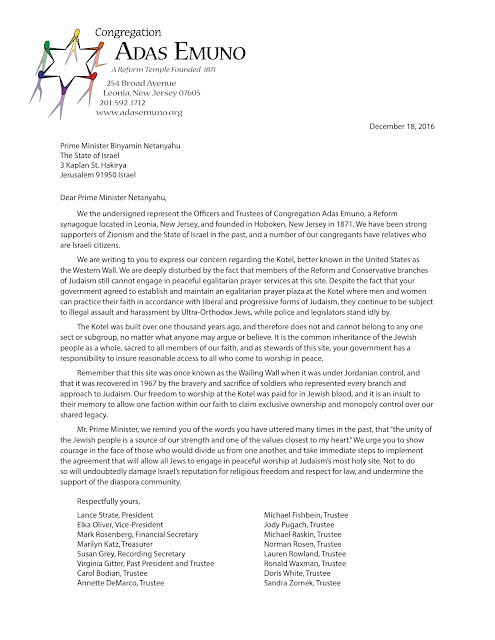
As we explained in detail in our previous post, Our Letter to Netanyahu, the Board of Trustees sent a letter to Israel's Prime Minister expressing our concern over the situation regarding egalitarian prayer at the Western Wall.

We did finally receive a response, which we would like to share with you here on our congregational blog:


Our goal was to make a statement, register our protest, and add to the pressure for an equitable solution, and while this response is pretty much pro forma, it does acknowledge the fact that we have added our voices to those of so many others in the Reform and Conservative movement. We hope, and pray, for a just resolution to this issue.

Saturday, February 25, 2017

Our Letter to Netanyahu

This past fall, Trustee Norm Rosen brought up the issue of egalitarian prayer at the Western Wall, or Kotel, to the Board. For more about the controversy, see the following article from the Forward website: With Western Wall Prayer Deal Dead, Orthodox Stake Brazen Claim to Egalitarian Area.

After much discussion, a letter was drafted, revised, signed by the officers and all but one of the Trustees of Congregation Adas Emuno, and delivered (via the internet) to the Prime Minister of the State of Israel, Benjamin Netanyahu.

As we consider this an open letter as well, we are sharing it here on our Congregational blog:


Sunday, August 2, 2015

Jewish Life in Colonial America

We're grateful to Cantor Sandy Horowitz for sharing with us the sermon she delivered on Friday evening July 3rd, the eve of the Shabbat that coincided with America's Independence Day:


July 3, 2015

Since it’s almost July 4th and we are in a synagogue, I thought I would spend a few minutes talking about the Jews who first came to this country before the Revolutionary War. 
Jews in Colonial America were certainly free of the overt persecutions and forced conversions to Christianity that had been their experience in Europe; however they weren’t exactly free to live on an equal basis with their Protestant counterparts. (Nor for that matter were the Catholics.) 

The first group of North American Jews landed in New York–then known as Dutch New Amsterdam –arrived in 1654. There were 23 of them, primarily traders and merchants, and they came from Brazil after having fled persecution in Europe.

Since New Amsterdam was Dutch, and Holland was known for its religious tolerance, these Jews figured they had it made. Unfortunately, Governor Peter Stuyvesant didn’t see it that way; he didn’t want Jews to settle in his colony. But economics prevailed over prejudice, as the Dutch West India Company was interested in these Jewish traders, and effectively convinced Stuyvesant to let them stay.

And so they were allowed to trade and to own real estate. However they were not permitted to hold public office, open a retail shop, or establish a synagogue.

When in 1664 the English captured New Amsterdam from the Dutch and renamed it New York, life for the Jews remained essentially the same. 

As public worship was seen as a threat to the Protestant way of life and was therefore forbidden, Jews prayed privately in a mill loft, which they made into a makeshift synagogue.

For those of you who heard Rabbi Schwartz speak last week about the history of Charleston's African Methodist Episcopal church, we recall that just as Jews prayed privately and in secret in colonial times, so too–in a far more violent climate–did our southern African-American counterparts find ways to pray together even when it was forbidden. 

In any case, the mill loft was the precursor to the first publicly known synagogue Shearith Israel, which was consecrated around 1720, and which exists as a congregation to this day. But I’m getting ahead of myself.

So, what was Jewish religious life like during this time? These were Sephardic Jews, and for the most part they maintained their Orthodox religious observance. Remember, the Reform and Conservative movements didn’t exist yet. However, once in America, there was a relaxation of observance among some at least, when it came to dietary laws and keeping the Sabbath. It’s known for example that Jews served in the army during the Revolution, where they certainly would have not kept kosher or observed Shabbat.

What’s more, during this time, Colonial Jews chose not to import ordained Rabbis from Europe, as their sister congregations in the Caribbean and South America had done. And so there was no one whose role was to decide on matters of ritual law (halakha), make sure people kept kosher, or be a model for Jewish scholarship and learning. This didn’t change until the 1830s. When disputes arose, unlike the European model where issues were resolved within the Jewish community, here in the colonies, Jews like everyone else relied on civil authority. This was new.
So–who led the congregations in worship? It was the Cantor, known as the Hazzan-Minister.

In fact, the area where the colonial Jewish community was most strict about adherence to tradition, was with its music–Torah cantillation and their liturgical melodies. And so they did import trained cantors–hazzanim–from Amsterdam and London.

Along comes the Revolutionary War. When the British army advanced into New York, most of the members of Shearith Israel, who sided with the rebels, took their Torahs and fled first to Connecticut and four years later, to Philadelphia where they founded a new synagogue, Mikveh Israel. Meanwhile, some members of Shearith Israel, who were loyal to England, remained in New York. Here we may have just witnessed the first congregational ideological split.

Shearith Israel congregation still exists today: to borrow from Guys and Dolls, it’s the “oldest established permanent floating synagogue” in New York. It floated up from its first home on Mill Street downtown to the upper west side where it’s an active synagogue today. 

So that’s New York, what about the Jews of New Jersey? Although it wasn’t until the mid 1800s that there were known established Jewish communities, Jewish merchants from New York and Philadelphia did conduct business in New Jersey during the colonial period. Among the first Jewish settlers were Aaron and Jacob Lozada, who owned a grocery and hardware store in Bound Brook as early as 1718. Daniel Nunez appears in a 1722 court record as town clerk and tax collector for Piscataway Township and justice of the peace for Middlesex County. This may be earlier than their New York counterparts would have been allowed to hold civic office.

In any case, it was the war that led to a change in status of American Jews. 

As I mentioned, Jews for the most part sided with the rebels; they signed non-import agreements, promising not to trade with the England, and many enlisted in the Continental Army and the various militias. They served as soldiers and in some cases as officers. Some Jewish merchants also made significant financial contributions to the revolutionary war cause. After the war, George Washington as President wrote to several of the Jewish congregations thanking them for their contributions and their service.

Over time, the newly formed states loosened their policies regarding the restriction of voting to Protestants only, and by the early 1800s Jews were given the right to vote–(Jewish men, that is…).
We had it easy compared to our African-American counterparts, who didn’t get the vote until much later, and who had a far more violent history than we ever did in this country. But our colonial American history should serve as a reminder that we too have had to struggle for equal treatment under the law even here, in the land of freedom whose birth we celebrate this weekend. 

In a 1790 letter to the Newport Rhode Island Congregation, George Washington wrote: "May the children of the stock of Abraham, who dwell in this land, continue to merit and enjoy the good will of the other inhabitants, while everyone shall sit safely under his own vine and fig tree and there shall be none to make him afraid. [Michah]" 

May this beautiful image one day come true for all Americans, and may we help to make it happen.

Shabbat shalom.


Sunday, May 4, 2014

The Rabbi’s Top 10 Jewish Modern Events

This past Monday, April 28th, was Yom HaShoah, Holocaust Remembrance Day, this coming Monday, May 5th, tomorrow that is, will be Yom HaZikaron, Israel's Memorial Day, and the day after that, Tuesday, May 6th, will be Yom HaAtzma'ut, Israel's Independence Day.

In honor of this sequence of highly significant commemorations, we are pleased to repost here on our blog Rabbi Schwartz's list of the ten most important modern Jewish events, which originally was published on April 24th in his online column for the Times of Israel, under the heading of The Rabbi’s Top 10 Jewish Modern Events:


As we approach Yom HaShoah, Holocaust Remembrance Day, I offer a history list – my compilation of the most consequential events of modern Jewish history. As always, I welcome your comments.

1. Spinoza’s Excommunication—Launched thinker’s epic contribution to “modernity” and the notion of the secular Jew.

2. Mendelssohn’s “Jerusalem”First modern attempt to reconcile faith and reason.

3. Rise of HasidismKabbalistic spirit becomes energizing movement.

4. Parisian SanhedrinChallenges of citizenship become evident.

5. Frankfort Rabbinical ConferenceReform of Judaism finds its place even as a backlash ensues that helps create Conservative and Modern Orthodox denominations.

6. Emigration to AmericaDemographic shift begins to the new world.

7. Dreyfuss TrialPersistence of anti-Semitism shook Herzl and Europe.

8. First Zionist CongressHerzl’s reply and the first achievement of modern Zionism.

9. HolocaustTragedy on an unimaginable scale.

10. Birth of Modern IsraelTriumph on an unimaginable scale.

Previous posts in this series include The Rabbi’s Top Ten: The Best of Everything Jewish, and The Rabbi’s Top 10 Jewish Foods

Tuesday, June 19, 2012

More Debate

Rabbi Schwartz recently published an op ed piece in The Jewish Exponent, dated June 6, 2012, with the title of Opinion: We Need More Debate in the Community, Not Less.  


As you may recall, our Rabbi is the author of the recently published book, Judaism's Great Debates: Timeless Controversies from Abraham to Herzl, and we're pleased to be able to share with you his recent opinion piece here, as well:


Some will tell you that we need less debate in the Jewish community, that for the sake of unity we need to stifle dissent and limit the amount we argue. I say that we need more debate, and that we will emerge the stronger for it. But what we need is the right kind of debate. 
Some will tell you that we need less denominational division in the community, again for the sake of Jewish unity. Such was the view of certain individuals at a major forum in Philadelphia in early May when leaders of the Reform, Conservative, Orthodox and Reconstructionist movements met in dialogue. I say we need more diversity, not less, and that we will emerge the stronger for it. But what we need is the right kind of diversity, the kind that respects pluralism and affirms the truth that what unites us is greater than what divides us.

Debate is not only desirable but is central to Judaism. Heroes of every era of our history -- Abraham, Moses, Yochanan Ben Zakkai, Hillel, the Vilna Gaon, Abraham Geiger, Theodor Herzl -- engaged in great debates.

Perhaps the most famous debating pair in Jewish history was Hillel and Shammai (after Abraham and God, that is). In actuality, it was not these two sages but their disciples that did most of the arguing. A wonderful passage in tractate Eruvin states: "For three years, there was a dispute between Beit Hillel and Beit Shammai, the former asserting, the law is in agreement with our views, and the latter contending, the law is in agreement with our views. Then a voice from heaven announced: eilu v'eilu divrei Elohim hayim, both are the words of the living God." Deep respect is given to both schools because both are speaking the truth as they see it, and have the welfare of the community in mind.

Samson Raphael Hirsch, a 19th century German rabbi and commentator, wrote that although in practice one viewpoint usually prevails (the law went according to Beit Hillel almost every time), both views "will have permanent value" because they "shed new light on the issue under debate, and will have contributed to the attainment of the proper understanding of the question discussed." They shall be remembered as "advancing the cause of the genuine knowledge of truth."

Rabbi Nachman of Bratslav went further, calling debate a holy form of communication because it echoes the divine process of tzimtzum, making space for the creation of something new. Just as God enters into an act of self-limitation in order to make possible the created world, so worthy debaters restrain themselves in order to make room for opposing viewpoints.

When we speak about the denominations of modern Judaism, it is important to remember that their very origins emerged in part from a significant debate in mid-19th century in Germany, the birthplace of modern Judaism as we know it.

The debate unfolded over a 10-year period (1836-1846) among three giants of modern Judaism who actually knew and liked each other.

Rabbi Abraham Geiger,, arguing that Judaism has always evolved with the times, called for critical study of Torah, the elimination of outdated prayers and the equal treatment of men and women.

Rabbi Samson Raphael Hirsch, while acknowledging the need to engage in secular learning in the new age, contended that Judaism's truths and law were eternal and not subject to evolution.

Rabbi Zecharias Frankel, an advocate of "moderate reform," famously stormed out of an 1845 Reform conference in Frankfurt over the elimination of Hebrew from some of the liturgy.

Geiger, Hirsch and Frankel became known, respectfully, as the "fathers" of Reform, Orthodox and Conservative Judaism. While the central locale of the debate soon shifted to America, it was these three who set the stage.

Regrettably, the debate put serious strains on their friendship, which was unfortunate because their honest debate affirms what British Chief Rabbi Jonathan Sacks calls "the dignity of difference" and has enriched the Jewish world.

What your mother taught you is true: You can disagree without being disagreeable. A true debater must respectfully listen to the opposing viewpoint in order to articulate a response. If only we could remember that despite our differences, we are actually on the same team, that because of our differences we will emerge more enlightened. Our arguments are, as the Talmud teaches, "for the sake of heaven," and that in the act of debate we are echoing the divine.  


We at Adas Emuno believe that Rabbi Schwartz presents an altogether persuasive argument in favor of debate in the Jewish community, making it clear that respectful debate benefits us all in a manner that can only be considered exponential.


Thursday, April 26, 2012

Where the Debate on Modern Judaism Really Began

Here now is the third and final post from the Jewish Book Council's website, written by Rabbi Schwartz as a guest blogger there, in conjunction with the recent publication of his new book, the student edition of Judaism's Great Debates, with the adult edition due out next month.  Once more, we're pleased to be able to share these posts with you here on the official blog of Congregation Adas Emuno.


The mid-19th century in Germany is, to my mind, the most unappreciated period in Jewish history. The reason is simple: modern Judaism as we know it was born then and there. Do I exaggerate? I think not. Spinoza’s revolutionary thought in the mid-17th century certainly paved the way for new thinking (see Chapter VIII of my book). Mendelssohn’s attempts in the late 18th century to reconcile faith and reason lay the groundwork within the Jewish community. The early reforms of Israel Jacobson, along with the responses of the Parisian Sanhedrin to Napoleon in the first decade of the 19th century mark the irreversible first steps of putting theory into practice.


But modernity hits its stride in Judaism in the second decade of the 19th century. In 1817 the Hamburg Temple embraces reform of Judaism as its raison-d'être. In 1819 Leopold Zunz establishes the pioneering Society for the Culture and Science of Judaism, which advocates for the academic study of our sacred texts and religious heritage. The same year a leading traditionalist rabbi, Moses Sofer, castigates this approach in his broadside Eleh Divrei Habrit. The grounds for the great debate have been set.


The debate truly unfolds over a ten year period (1836-1846) between three giants of modern Judaism who were contemporaries, and actually knew and liked each other (until their disagreements drove them apart). Rabbi Abraham Geiger began arguing that Judaism has always evolved and should continue to change with the times. He called for radical shifts to meet the demands of modernity, including the critical study of Torah, the elimination of outdated prayers and customs, and the equal treatment of men and women. Rabbi Samson Raphael Hirsch, while acknowledging the need to engage in secular learning in the new age, contended that Judaism’s truths and law were eternal and not subject to evolution. Rabbi Zecharias Frankel, an advocate of “moderate reform” famously stormed out of an 1845 conference in Frankfort over the elimination of Hebrew from some of the liturgy.


Rabbis Geiger, Hirsch, and Frankel became known, respectfully, as the “fathers” of Reform, Orthodox, and Conservative Judaism. The spectrum of modern denominational Judaism was born in that time and place. Chapter IX of my book chronicles this remarkable debate. While the central locale of the debate would soon shift to America it was these three German Jewish leaders, through their sermons, books, and organizational activities who set the stage. Though hardly household names in the Jewish community today, we owe a debt of gratitude to their great debate. I once taught a course about them called “The Three Tenors of Modern Judaism.” Their magnificent voices created the opera we sing today.